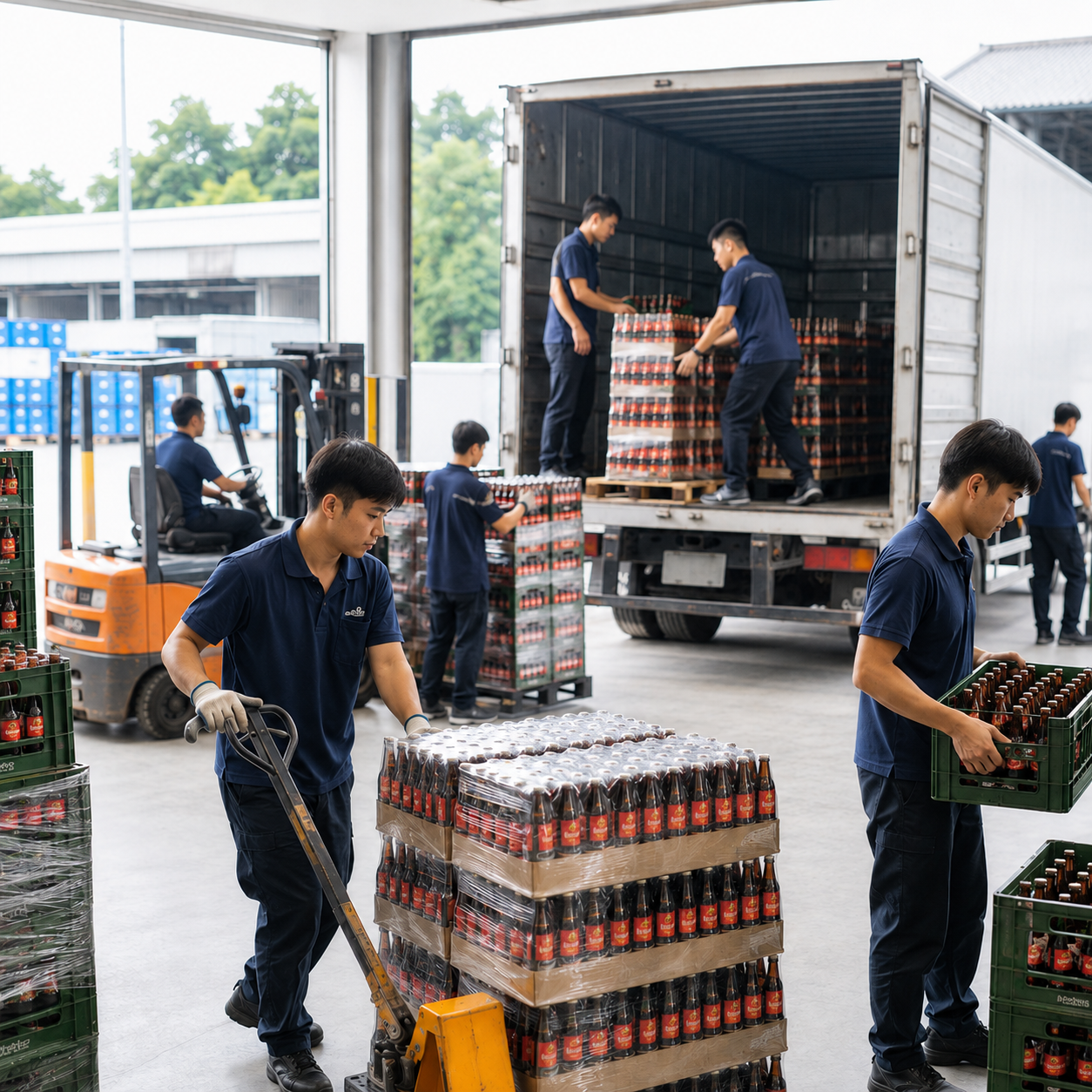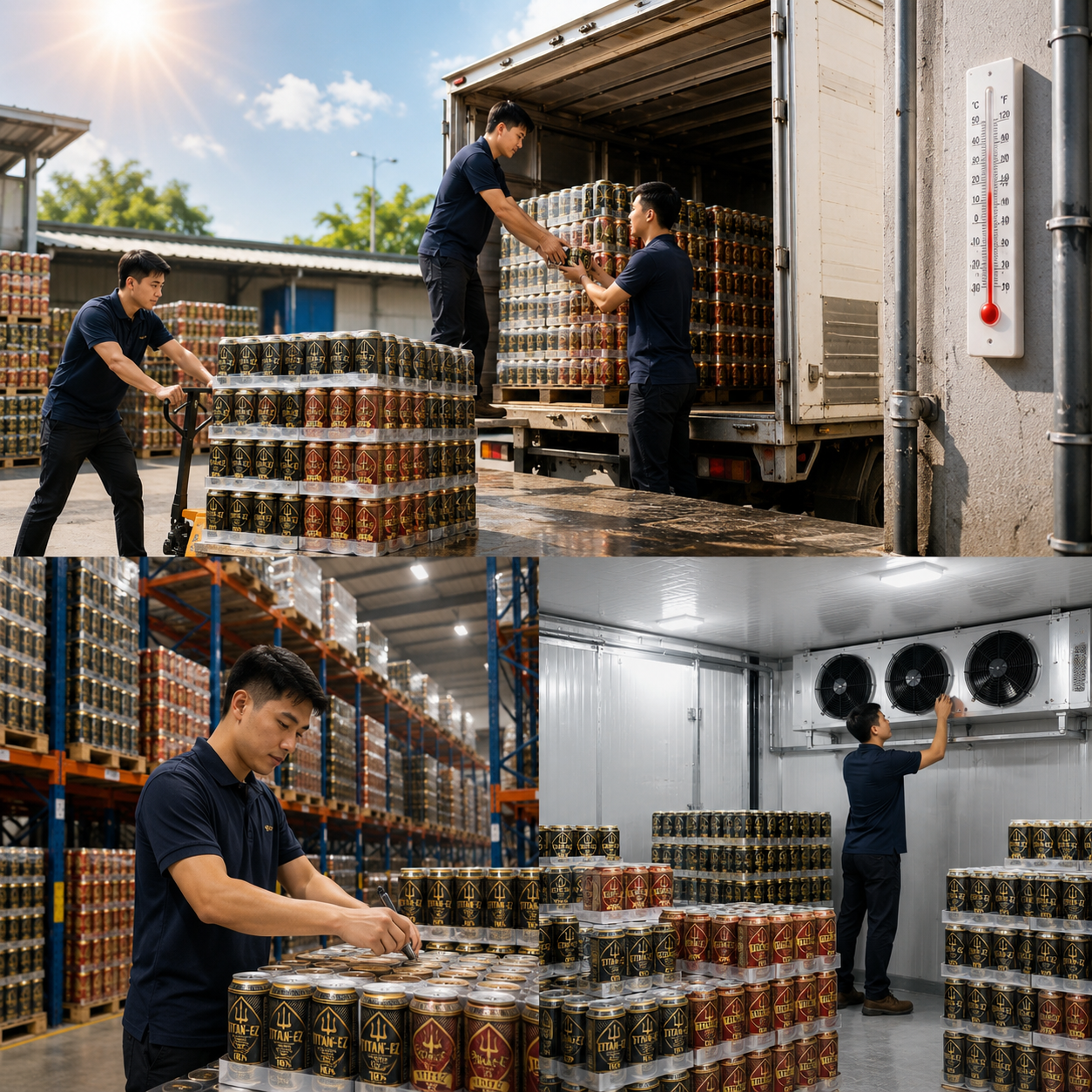


When evaluating the quality of a beer product, consumers often focus on flavor, consistency, packaging, and the overall consumption experience. For businesses manufacturing or developing private-label beer brands, quality also depends on a broader system operating behind the brewery: the supply chain.

From raw materials and packaging supplies to production planning, warehousing, and distribution, every link in the supply chain can affect the final product. Even with a well-developed formulation, inconsistent raw materials, delayed packaging supplies, or improper storage conditions can create risks for business operations.
Therefore, beer supply chain management is not simply about transporting goods from one location to another. It is also an integral part of the quality management system.
For businesses choosing OEM beer manufacturing, the supply chain requires an even more comprehensive approach because brand operations involve coordination among the manufacturing facility, material suppliers, brand owners, and distribution networks.
So, how can an effectively managed supply chain help improve and maintain beer product quality?
Beer Quality Begins with the Ability to Control Raw Material Sources
One of the first links in the beer supply chain is raw materials.
Water, malt, hops, yeast, and other ingredients appropriate to each formulation all contribute to the development of the product’s characteristics. Therefore, finished product quality cannot be separated from the selection, receipt, and management of raw materials.
Effective supply chain management first enables manufacturers to establish a controllable system for incoming materials.
The key is not simply finding suitable raw materials at a particular point in time, but also maintaining consistency throughout continuous production. If the characteristics of incoming materials vary significantly between batches, maintaining a consistent product experience becomes more challenging.
Raw material traceability also requires careful attention.
When each batch of raw materials has clear information about its source, receipt date, and usage history, manufacturers have a stronger foundation for controlling production and identifying potential causes when issues require investigation.
For a growing beer brand, raw material sourcing is also closely related to scalability.
A particular raw material source may adequately support initial production volumes but may not necessarily meet demand when production increases rapidly. Therefore, supply chain management must look beyond individual orders to evaluate the long-term availability of suitable raw materials.
From this perspective, quality does not begin when the production line starts operating. It begins with how businesses and manufacturing facilities establish stable sources of raw materials.
If your business is developing a private-label beer product and would like to discuss contract manufacturing options, SMB is ready to receive your project requirements via Email: Oem@biasaigonmt.com.
Supplier Management Helps Reduce Variability in the Production Process
An effective supply chain requires not only suppliers capable of delivering goods but also a system for evaluating the suitability of the materials they provide.
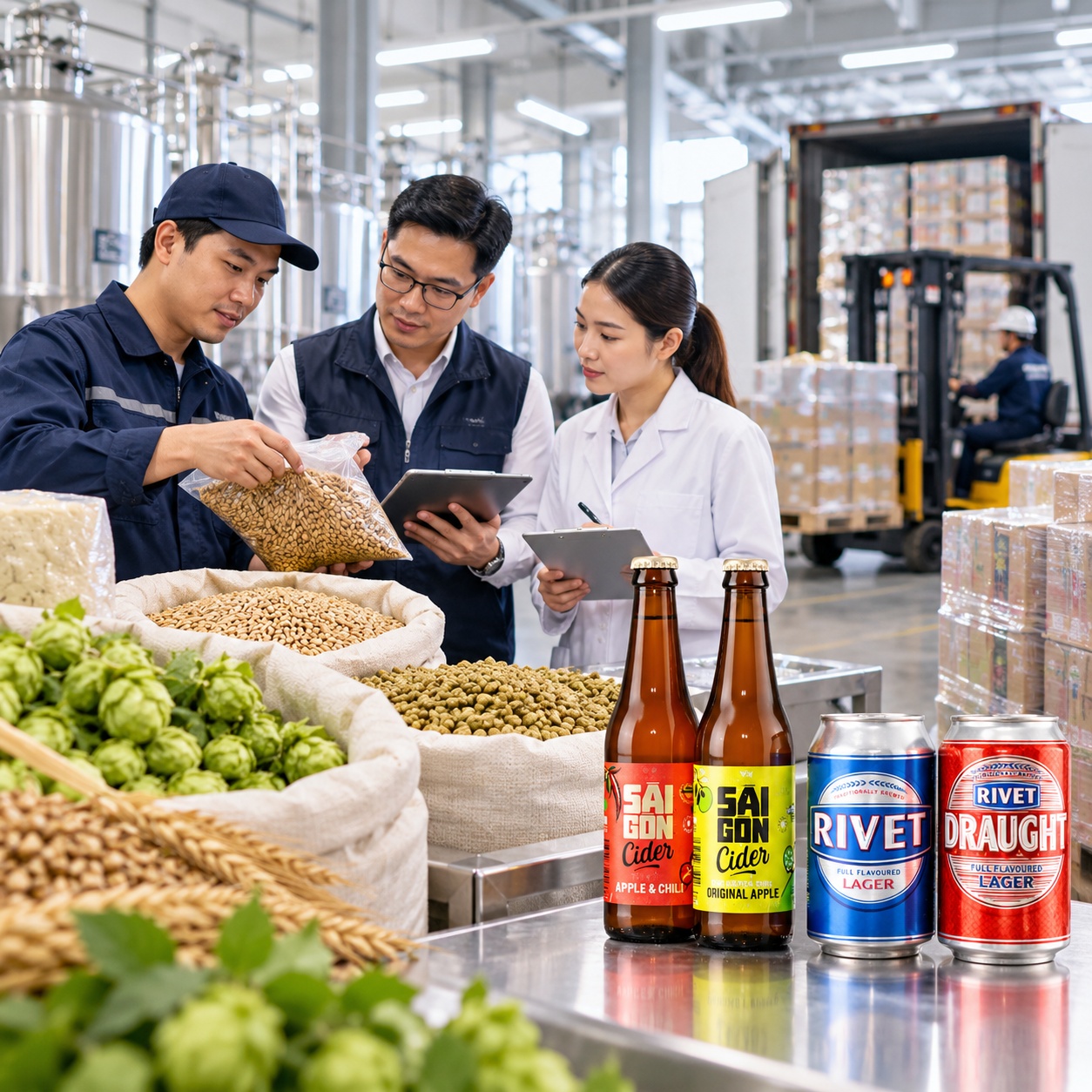
In beer production, this applies to both raw materials and packaging supplies.
If raw materials deviate from the required specifications, the production process may experience additional variability. If cans, bottles, labels, or cartons do not meet the specified requirements, packaging schedules may also be affected.
Therefore, supplier management should be regarded as an integral part of quality management.
Rather than selecting suppliers based solely on price, businesses need to consider their ability to meet technical requirements, maintain consistency, deliver on schedule, and cooperate when problems arise.
A lower purchase price does not necessarily mean a lower total cost.
If a batch of unsuitable materials causes production delays or requires replacement, the resulting costs may exceed the initial savings. For brands that have scheduled product launches or committed to delivery timelines with distribution networks, the impact may also extend to sales operations.
This is why purchasing decisions should be aligned with production plans and quality standards rather than made independently.
When suppliers, purchasing departments, and production teams work according to unified requirements, the risk of discrepancies between purchased materials and actual production needs is reduced.
For OEM projects, a manufacturing facility’s ability to manage its supply network is therefore an important factor businesses should consider when evaluating potential partners.
Businesses interested in learning more about product specifications, packaging, and OEM beer manufacturing options can contact SMB’s OEM department via Email: Oem@biasaigonmt.com for consultation.
Supply Planning Must Be Aligned with Production Planning
Even raw materials and packaging supplies that meet quality requirements can disrupt operations if they do not arrive at the right time.
This demonstrates the close relationship between quality and production schedules.
A beer production plan typically depends on the availability of multiple resources. If an essential material is not supplied according to schedule, production or packaging plans may need to be adjusted.
Conversely, purchasing excessive quantities of raw materials and supplies too early is not necessarily an effective solution.
High inventory levels increase storage requirements, tie up working capital, and extend the time materials remain in storage. For ingredients with specific storage requirements, inventory conditions must be managed even more carefully.
Therefore, supply chain management needs to establish a balance between maintaining sufficient materials for production and avoiding unnecessary excess inventory.
For brands using OEM manufacturing, businesses also play a role in achieving this balance.
If order plans change frequently or production volume forecasts are provided too late, manufacturing facilities may struggle to prepare the necessary resources proactively. As a brand grows, sharing demand forecasts within a reasonable planning horizon helps manufacturers prepare production activities more effectively.
Businesses should therefore develop forecasts based on sales velocity, inventory levels, retail network expansion plans, and seasonal factors.
When market information is translated into production plans early, the entire supply chain has more time to prepare.
If your brand is entering a period of increasing production volumes and requires more proactive contract manufacturing planning, you can discuss your requirements with SMB via Email: Oem@biasaigonmt.com.
Proper Inventory Management Helps Protect Beer Quality
Once production is complete, the quality management process does not end.
Beer must undergo storage and distribution before reaching consumers. Storage conditions during this stage can affect the product’s final consumption experience.

Therefore, inventory management needs to be considered from two perspectives simultaneously: financial performance and product quality.
Excessive inventory ties up working capital in stored goods and may extend the time products remain in warehouses. Meanwhile, insufficient inventory increases the risk of stock shortages and distribution disruptions.
An appropriate inventory management system should be based on sales velocity and replenishment plans.
For beer products, batch management is also particularly important. Information about production dates, batch numbers, and storage periods helps businesses manage product rotation more proactively.
Prioritizing appropriate batches according to production dates and expiration dates helps prevent newer products from being dispatched first while older inventory remains in storage.
This becomes especially important when a brand begins expanding its network of distributors.
Businesses need to manage not only their central warehouses but also inventory levels throughout the distribution network. If products enter distribution channels faster than they are sold to consumers, they may remain in storage longer than expected.
Therefore, sell-in metrics should be evaluated alongside sell-out performance and actual inventory levels.
The quality of products reaching consumers is not solely the result of manufacturing operations. It also depends on how products are managed after leaving the production line.
Businesses developing production volume plans for their distribution networks can contact SMB via Email: Oem@biasaigonmt.com to discuss suitable contract manufacturing requirements.
Transportation and Distribution Are Extensions of Quality Control
A product may meet quality requirements when it leaves the factory, but it still needs to be managed appropriately throughout transportation and distribution.
This is why businesses should not view logistics simply as delivering goods to the correct address.
Transportation conditions, the time products spend at transit points, and storage methods within distribution networks are all factors that require attention.
As a brand expands its market coverage, transportation distances become longer and the number of intermediaries increases, making the supply chain more complex.
Businesses need to understand which stages their products pass through before reaching retail outlets.
Batch traceability is particularly valuable in this situation. If a quality-related complaint arises, businesses can identify the relevant production batch, the regions where the products were distributed, and the locations potentially involved.
This provides a stronger foundation for investigating the issue.
Effective distribution management also helps prevent situations in which one region experiences stock shortages while another holds excessive inventory. Regional sales and inventory data can be used to adjust product allocation plans.
When supply chains operate based on data, the objective is not simply to move the largest possible quantity of products into the distribution network.
The objective is to deliver the right quantity of products to the right markets at the appropriate time, while maintaining the necessary conditions to protect product quality.
To discuss contract manufacturing plans aligned with your brand’s distribution requirements, businesses can send project information to Oem@biasaigonmt.com for consultation with SMB’s OEM department.
Data Helps Connect Supply Chain Management with Quality and Growth
When a brand operates on a small scale, businesses may be able to manage their supply chains using a few simple tracking spreadsheets. However, as production volumes, SKUs, and the number of retail outlets increase, data-driven decision-making becomes increasingly important.

Businesses need to know which products are selling quickly, how much inventory remains, and when to prepare the next production batch.
Data also helps identify irregularities.
If a particular region consistently holds inventory longer than average, businesses can reassess the quantities allocated to that market. If an SKU repeatedly experiences stock shortages, demand forecasts or safety stock levels may need to be adjusted.
Quality information should also be integrated into this system.
Feedback from retail outlets and consumers, batch-level data, and product quality control results help businesses understand the relationship between supply chain operations and actual market experiences.
Under the OEM model, information sharing between the brand owner and the manufacturing facility is particularly important.
Manufacturers need demand forecasts to prepare production plans. Businesses need information about production schedules to manage inventory and distribution. When both parties exchange data rather than simply handling individual orders separately, their planning capabilities improve.
As a brand grows, this represents the transition from purchasing based on immediate needs to planned supply chain management.
Such a system not only helps reduce the risk of stock shortages but also supports consistent product quality as business operations expand.
SMB respectfully invites businesses developing or expanding their private-label beer brands to contact its OEM department via Email: Oem@biasaigonmt.com to discuss production volumes and suitable contract manufacturing options.
A Stable Supply Chain Provides the Foundation for Consistent Beer Quality
Beer product quality is not determined solely during the time the beer spends on the production line.
Before production, raw materials must be selected and managed. Afterward, the product undergoes packaging, storage, transportation, and distribution. If any link in this chain operates inconsistently, the effects may extend to subsequent stages.
Therefore, effective supply chain management is an integral part of product quality management.
At the beginning of the supply chain, controlling suppliers and raw materials helps establish a stable foundation for production. Within the manufacturing facility, appropriate supply planning helps minimize disruptions. After production, inventory and distribution management help protect products as they move toward the market.
For businesses using OEM beer manufacturing services, the supply chain also serves as a connection between business planning and production capabilities.
When businesses accurately forecast market demand, manufacturers have a stronger basis for preparing production plans. When production schedules are established proactively, brands can manage inventory and distribution more effectively. When batch-level data is maintained, quality control and traceability also become easier if an issue requires investigation.
This is particularly important as a brand grows.
The larger the scale of operations, the more difficult it becomes for businesses to rely on immediate, reactive decisions. A well-planned supply chain system helps brands move away from constantly responding to stock shortages, excess inventory, or delayed material deliveries toward more proactive production and distribution management.
Ultimately, effective supply chain management is not solely about reducing costs.
Its more important value lies in creating a stable flow from raw materials to finished products, thereby supporting consistent quality, reliable product availability, and a uniform brand experience across the market.
Contact Information
To learn more about the company and receive consultation on OEM beer manufacturing services, please contact Sai Gon – Mien Trung Beer Joint Stock Company (SMB) through its official contact channels.
Company: Sai Gon – Mien Trung Beer Joint Stock Company (SMB)
Head Office Address: 01 Nguyen Van Linh, Tan An Ward, Dak Lak Province
OEM Consultation Hotline: (+84) 94 1127575
Dedicated Email: Oem@biasaigonmt.com
Official Website: https://oem.biasaigonmt.com/