

The beer industry is entering a new stage of development in which the market is no longer driven primarily by production volume expansion or distribution coverage. Consumer behavior is changing, demand is becoming increasingly segmented, production technology is advancing, packaging requirements are becoming more demanding, and supply chains must adapt to various fluctuations.

For businesses developing private-label beer brands, identifying these shifts is important when building product strategies. A particular trend may create opportunities for one market segment but may not necessarily be suitable for another. Therefore, businesses need to understand the nature of each change before deciding how to invest their resources.
Market changes also directly affect OEM beer manufacturing. As product requirements become increasingly specific, OEM manufacturing is no longer simply about finding a company capable of producing beer. Businesses need to clearly define their target customers, product direction, packaging, production volumes, and development plans before implementing a project.
Below are six notable trends that may shape how businesses approach the beer industry in the new era.
1/ The Beer Market Is Becoming Increasingly Segmented According to Customer Needs
One of the most noticeable changes is that market demand is becoming increasingly difficult to view as a single, homogeneous group. Customers with similar demographic characteristics may still make different purchasing decisions depending on the circumstances, spending levels, purchasing channels, and product expectations.
This makes developing a single product intended to serve an overly broad customer base increasingly challenging. Instead, businesses need to clearly understand which customer needs their products are designed to meet and which market segments they are targeting.
Distribution channels also contribute to these differences.
A product distributed widely through retail channels must address challenges related to shelf visibility, pricing, and inventory turnover. Meanwhile, products intended for restaurants, hotels, or resorts may be positioned within an entirely different customer experience.
Therefore, market research in the new era needs to go beyond basic criteria such as age or income. Businesses need to understand the circumstances in which customers choose products, the factors influencing their decisions, and which unmet needs remain insufficiently addressed.
When this information is established from the beginning, the process of working with beer manufacturing partners also becomes clearer. A project brief containing information about the target segment, product direction, packaging specifications, and expected production volumes provides a stronger foundation for subsequent development stages.
Have you identified your target market segment but are still considering how to translate market demand into a product? Share your plans with SMB’s OEM department via Email: Oem@biasaigonmt.com to discuss suitable contract manufacturing options.
2/ Beer Product Portfolios Are Becoming More Diverse to Meet Different Needs
As consumer needs become more segmented, product portfolios are also tending to expand. Alongside traditional beer varieties, non-alcoholic and low-alcohol options are emerging as notable development directions for the industry in many markets.

However, diversification does not mean businesses need to continuously introduce new SKUs.
Every new product brings a series of requirements related to product development, packaging materials, production planning, inventory, distribution, and commercial management. If the product portfolio expands faster than the business’s management capabilities, increased complexity may reduce operational efficiency.
Therefore, the key question before developing a new product is: What role will this beer product play in the existing portfolio?
If the product helps reach a market segment, customer need, or sales channel that the brand does not currently serve effectively, expansion may have a clearer strategic foundation. Conversely, if the new product is too similar to an existing SKU, sales may be divided among product lines rather than generating additional demand.
Portfolio management will therefore become increasingly important. Businesses need to monitor the role, sales velocity, reorder potential, operational efficiency, and strategic alignment of each product.
For OEM beer production, a clearly structured product portfolio also helps businesses plan production volumes, packaging requirements, and production schedules for individual SKUs more proactively.
A new product idea needs to be evaluated in terms of both market demand and production feasibility. SMB is ready to receive project information and discuss OEM manufacturing options via Email: Oem@biasaigonmt.com.
3/ Technology and Data Are Becoming Increasingly Integrated with Quality Management
Technology in the beer industry is not solely intended to increase productivity. Its increasingly evident value lies in the ability to control production processes, monitor data, and help maintain consistency across product batches.
When information about raw materials, production processes, and finished products is managed systematically, businesses have a stronger foundation for identifying variations and tracing information when an issue requires investigation.
Data also helps connect manufacturing facilities with market demand.
If a brand understands its sales velocity, inventory levels, and retail network expansion plans, production order quantities can be calculated more accurately. This helps reduce the risk of excessive inventory while also minimizing product shortages when demand increases.
Therefore, the ability to use data is becoming increasingly important to growth management.
When selecting an OEM beer manufacturing facility, businesses should not focus solely on whether a partner can manufacture the product. Quality control procedures, traceability capabilities, coordination methods, and production planning processes are also important areas to evaluate.
This is particularly relevant when a brand expects to increase production volumes in the future. Establishing a clear coordination system from the beginning can help reduce potential problems as order volumes grow.
Looking for a manufacturing solution for your private-label beer brand? Businesses can send their product requirements and expected production volumes to Oem@biasaigonmt.com to discuss project needs with SMB’s OEM department.
4/ Beer Packaging Is Becoming a Comprehensive Business Consideration Rather Than Just a Design Element
Packaging has long played an important role in product recognition. However, in the new era, an effective packaging solution must address more than simply creating an eye-catching appearance.

Businesses need to consider brand identity, materials, packaging specifications, production feasibility, MOQ, storage, and transportation simultaneously. Requirements related to environmental impact and the packaging life cycle also demand increasing attention.
This means packaging development requires early coordination between the brand and the manufacturing team.
A design may look impressive in a mockup but may not necessarily be suitable for actual production. Conversely, making decisions based solely on production convenience may make it difficult for the product to stand out at retail outlets.
The challenge lies in finding the right balance.
Marketing teams need to understand the limitations of production specifications, while operations teams need to understand the brand’s identity objectives. Material suppliers and manufacturing facilities should also be involved early enough for businesses to evaluate implementation feasibility.
The growing emphasis on sustainable development makes these decisions even more significant. Material selection, packaging weight, and packing specifications can simultaneously affect costs, logistics, and environmental responsibility.
Therefore, packaging should be considered an integral component of product strategy, rather than a task completed only after the product formulation is finalized.
Already have a concept for labels, cans, bottles, or proposed packaging specifications? SMB’s OEM department is ready to discuss the requirements that need to be prepared before starting contract manufacturing. Project information can be sent via Email: Oem@biasaigonmt.com.
5/ Flexible Supply Chains Provide the Foundation for Scalability
When a brand operates on a small scale, businesses can manage production volumes and inventory relatively easily. However, as the number of SKUs, distribution regions, and retail outlets increases, supply chain management quickly becomes more complex.
Businesses need to maintain sufficient inventory to meet market demand while ensuring that stock levels do not exceed actual requirements. Raw materials and packaging supplies must also be prepared at the right time to align with production schedules.
Forecasting capabilities play a significant role in maintaining this balance.
Sales data, inventory levels, inventory turnover, and market expansion plans need to be integrated into production planning. When demand information is shared early, manufacturing facilities and other stakeholders have more time to prepare.
A flexible supply chain also requires the ability to respond to changes in materials, supply lead times, or market demand. If businesses only take action after problems arise, the risk of disruption may increase.
Under the OEM beer manufacturing model, coordination between brand owners and manufacturing facilities therefore becomes increasingly important as production volumes grow.
Rather than treating each order separately, both parties can discuss phased production plans to manage manufacturing activities and resources more proactively.
As your brand enters a period of increasing production volumes, contract manufacturing plans also need to be prepared earlier. Share your expected requirements with SMB via Oem@biasaigonmt.com to discuss production options for each stage of development.
6/ Standards, Compliance, and Sustainable Development Are Having a Greater Impact on the Beer Industry
Alongside market trends and technology, the beer industry is also directly influenced by requirements related to quality, food safety, product labeling, environmental protection, and industry-specific regulations.
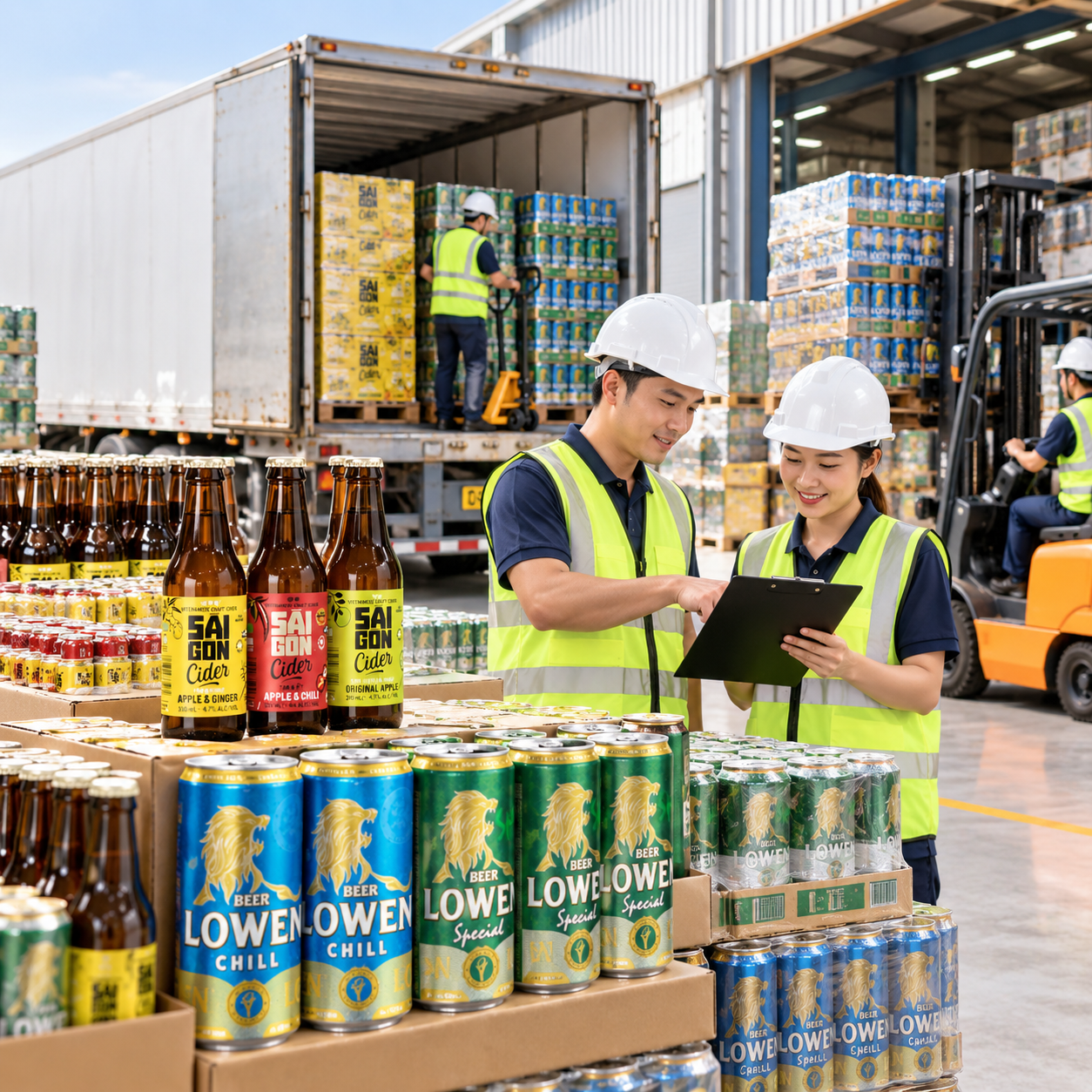
This means compliance requirements need to be considered from the very beginning of the product development process.
If businesses only begin reviewing requirements when packaging or product development is nearly complete, any necessary changes may affect project timelines and costs. Identifying the requirements that must be met in advance helps businesses manage projects more proactively.
When selecting an OEM manufacturing facility, businesses should also examine its quality control systems and the standards relevant to their project requirements.
If specific systems or certifications such as HACCP, ISO 22000, or other standards are required, businesses should verify the manufacturer’s actual documentation rather than making assumptions based on general information.
Alongside compliance requirements, sustainable development is becoming increasingly connected to operational efficiency.
Optimizing raw materials, water, energy, packaging supplies, and inventory can simultaneously influence resource efficiency and environmental impact. This is why sustainable development is increasingly viewed as part of production management rather than merely a communication activity.
As the business environment continues to evolve, the ability to adapt to standards and regulatory requirements will become an important aspect of a company’s long-term development capabilities.
Before moving a private-label beer project into production, various requirements related to the product, packaging, and manufacturing processes need to be clarified. SMB respectfully invites businesses to contact its OEM department via Email: Oem@biasaigonmt.com for consultation tailored to their specific project requirements.
Adaptability Will Shape Business Advantages in the New Era
The trends influencing the beer industry are closely interconnected. Increasingly segmented customer needs encourage businesses to develop more diverse product portfolios. Expanding portfolios make production and supply chain management more complex. Packaging must simultaneously meet commercial, operational, and environmental requirements, while data is increasingly becoming the connection between the market and manufacturing facilities.
Therefore, businesses do not necessarily need to follow every emerging market trend.
What matters more is the ability to identify which trends are genuinely relevant to their target customer segments and business models. A change that benefits one brand may not necessarily create similar value for another.
For businesses developing private-label beer brands, preparation before production is therefore becoming increasingly important. Target market segments, product roles, packaging specifications, expected production volumes, and requirements for manufacturing partners should be relatively clearly defined before a project moves into the implementation stage.
The OEM beer manufacturing model also needs to be considered within this broader context. Rather than simply addressing the production requirements of an individual order, businesses need to examine how OEM manufacturing activities can connect with product planning, supply chain management, and growth strategies.
In the new era, competitive advantages may belong to businesses that know how to connect market – product – data – production – supply chain into an adaptable system. When these elements are prepared in a coordinated manner, businesses will have a stronger foundation for responding to industry changes rather than making adjustments only after trends have become clearly established.
Contact Information
To learn more about the company and receive consultation on OEM beer manufacturing services, please contact Sai Gon – Mien Trung Beer Joint Stock Company (SMB) through its official contact channels.
Company: Sai Gon – Mien Trung Beer Joint Stock Company (SMB)
Head Office Address: 01 Nguyen Van Linh, Tan An Ward, Dak Lak Province
OEM Consultation Hotline: (+84) 94 1127575
Dedicated Email: Oem@biasaigonmt.com
Official Website: https://oem.biasaigonmt.com/