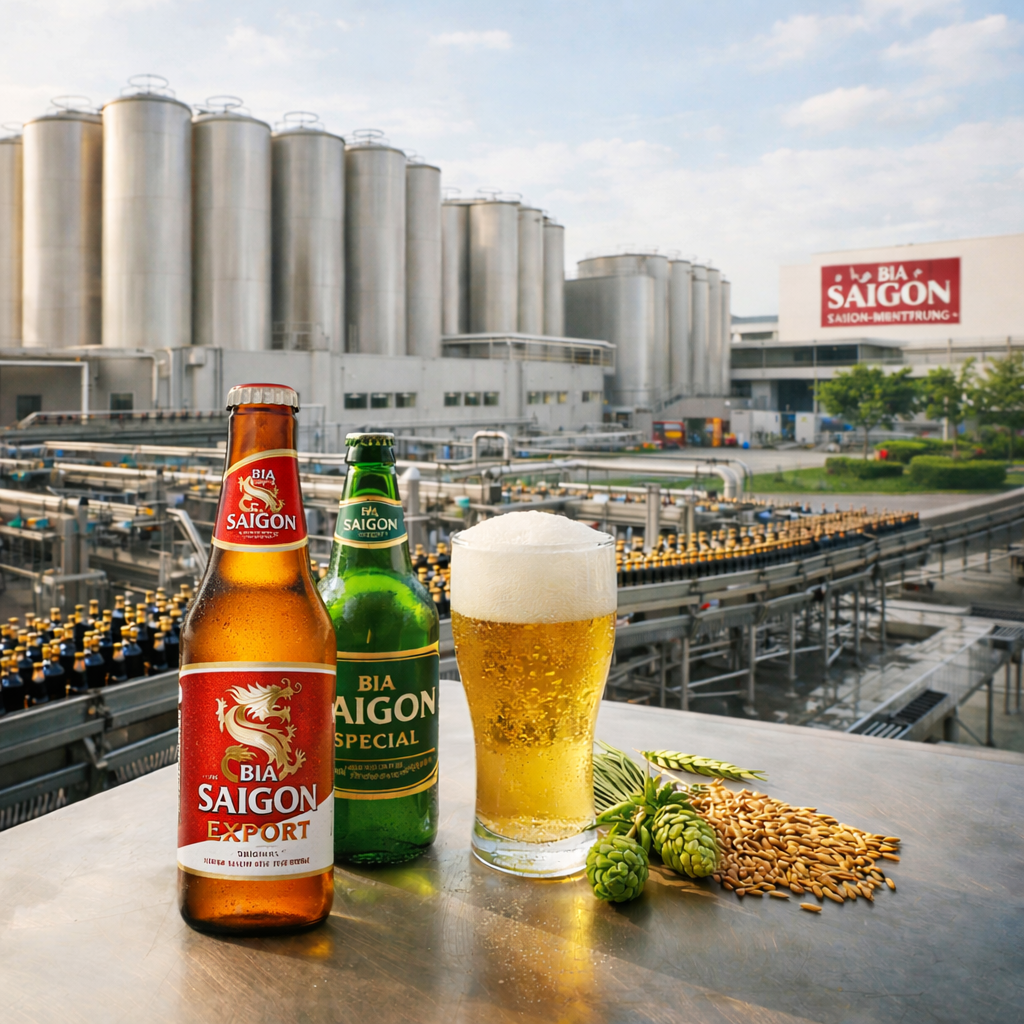



However, the development of the beer OEM model (private label beer manufacturing) is changing how brands enter the market. Instead of investing in a brewery, businesses can collaborate with large breweries to produce products under their own brand. In Vietnam, the OEM service of Saigon Beer – Central Region Joint Stock Company (SMB) is opening a new path for brands that want to enter the beer industry more flexibly and efficiently.
This article will analyze how the beer OEM model helps small brands compete in a market that is traditionally considered very difficult to access.
Why the beer market is difficult for new brands to access
To understand the value of the OEM model, we first need to look at the barriers faced by a new beer brand. Beer production is an industry with high technical requirements and significant investment. Building a brewery involves not only installing brewing lines but also managing complex systems such as water treatment, fermentation, beer filtration, filling, packaging, and quality control.
Investment costs for these components can be very high, while the construction and commissioning of a brewery often take several years. Once the brewery is operational, businesses must also maintain a technical team, testing laboratories, quality management systems, and many operational processes to ensure that the beer product meets standards.
Beyond production, a new beer brand must also compete with established brands in the market. Large brands typically have advantages in distribution networks, substantial marketing budgets, and high brand recognition. This makes it much more difficult for a new brand to establish a foothold.
For these reasons, many businesses are seeking more flexible models to enter the beer market without bearing the full initial investment cost. This is where the beer OEM model begins to demonstrate its value.
Beer OEM – a flexible approach to building a private label beer brand
Beer OEM is a collaborative model in which a business that owns a brand works with a brewery to produce products according to its specifications. Instead of investing in their own brewery, businesses can leverage the existing production capabilities of the partner brewery.
In this model, the brewery is responsible for production activities such as recipe development, brewing, fermentation, filling, and quality control. The business partnering through OEM retains ownership of the brand and product direction. This allows the business to focus more on brand building, market development, and expanding distribution channels.

One of the major advantages of OEM is the ability to significantly shorten the time-to-market. When working with a brewery that already has an established production system and industry experience, the product development process usually proceeds faster than building an entire system from scratch.
This flexibility has enabled many beverage brands worldwide to launch new products more quickly and adapt more effectively to market changes.
Beer OEM helps small brands gain a competitive advantage
For small businesses, competing with large brands is not always a race of scale. In many cases, flexibility and the ability to focus on the brand experience become critical advantages.
By using the OEM model, businesses can shift their focus from production investment to brand building. Instead of allocating substantial resources to breweries and equipment, they can concentrate more on marketing strategies, developing the brand story, and expanding their distribution network.
Another important factor is product quality. Large breweries often operate under strict quality management standards, with control systems spanning from raw materials to production processes. This ensures that beer products are consistently produced and meet food safety standards.
As a result, a new brand can offer high-quality products from the very beginning without having to build its own comprehensive quality control system.
Additionally, OEM allows businesses greater flexibility in testing new products. If the market changes or the business wants to develop a new beer line, adjusting the product is usually simpler compared to operating an independent brewery.

The Role of Sai Gon – Mien Trung Beer in the Beer OEM Ecosystem
In the context of the growing beer OEM model, the capability of the brewery is a decisive factor for product success. SMB is one of the long-established players in the beer industry, equipped with modern production systems.
As a member of the Sabeco system, SMB operates breweries with fully integrated production lines, from brewing and fermentation to filling and packaging. These systems are built according to international quality management standards, ensuring that beer products maintain stability and safety throughout the production process.
In addition to producing well-known beer brands on the market, SMB has developed OEM services to support businesses in creating private label beer. Under this collaboration model, the brewery not only acts as the production unit but also supports businesses in multiple stages of product development.
With extensive industry experience and large-scale production capacity, SMB can help businesses shorten the product development cycle and bring beer products to market more efficiently.
Private Label Beer – A Long-Term Opportunity for Small Businesses
The growth of the OEM model opens up new opportunities for businesses in the beverage industry. When production costs are no longer a major barrier, brands can focus on creating unique customer experiences.
For F&B chains, private label beer can become a key part of the brand experience. When customers enjoy a beer available exclusively at a specific restaurant or chain, the product becomes a differentiating factor compared to competitors.
For distribution companies, developing private label beer also expands their role within the value chain. Instead of merely distributing products from large beer brands, businesses can build their own brand and generate long-term value.
In many cases, a private label beer can even evolve into a retail product or be exported. When built with the right strategy, the product not only serves as a beverage offering but also becomes a valuable brand asset.
Beer OEM is becoming a crucial model that enables small businesses to enter the beer market more effectively. By leveraging the production capacity of large breweries, businesses can reduce initial investment risk, shorten product development timelines, and focus on brand building.