


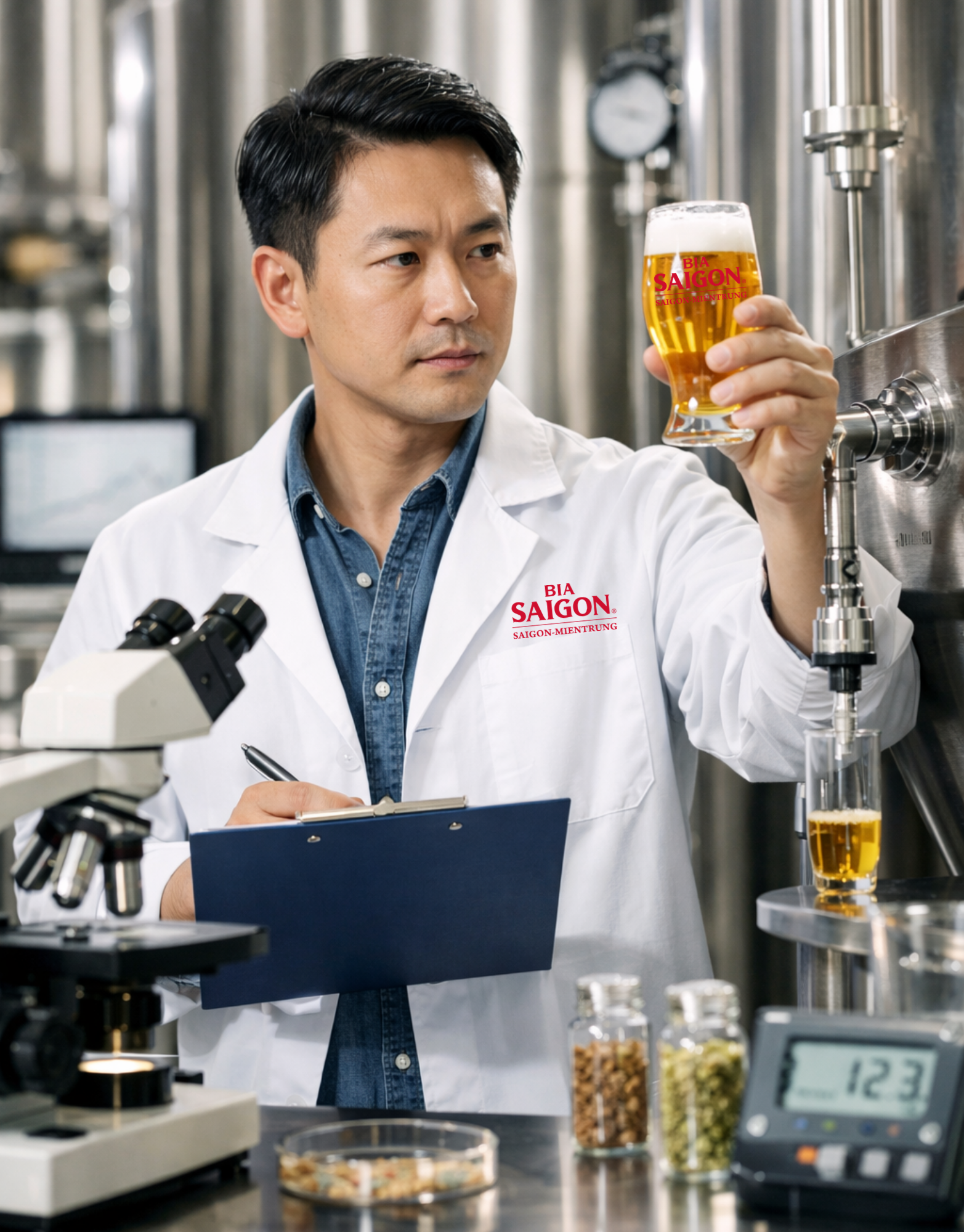
SMB operates a quality management system that meets HACCP and ISO 22000 standards, affirming that a well-structured beer quality control process is the true “insurance” for any brand. In Vietnam, one of the companies implementing a systematic beer OEM service under this approach is Saigon Beer Central Region Joint Stock Company (SMB)—a business equipped with modern beer production systems, synchronized filling lines, and internationally standardized quality management processes.
The following article analyzes in detail the QC system in a standard-compliant brewery and explains why it is a critical factor for private label beer brands.
The importance of QC in the beer industry – When consistency defines reputation
In beer production, “good taste” is not the only criterion. A product may impress consumers on the first try, but if subsequent batches differ in flavor, consumer trust will be lost immediately.
Beer quality is evaluated based on:
- Accurate alcohol content (ABV)
- Stable bitterness (IBU)
- Residual sugar level (Plato)
- Color and foam stability
- Microbiological safety
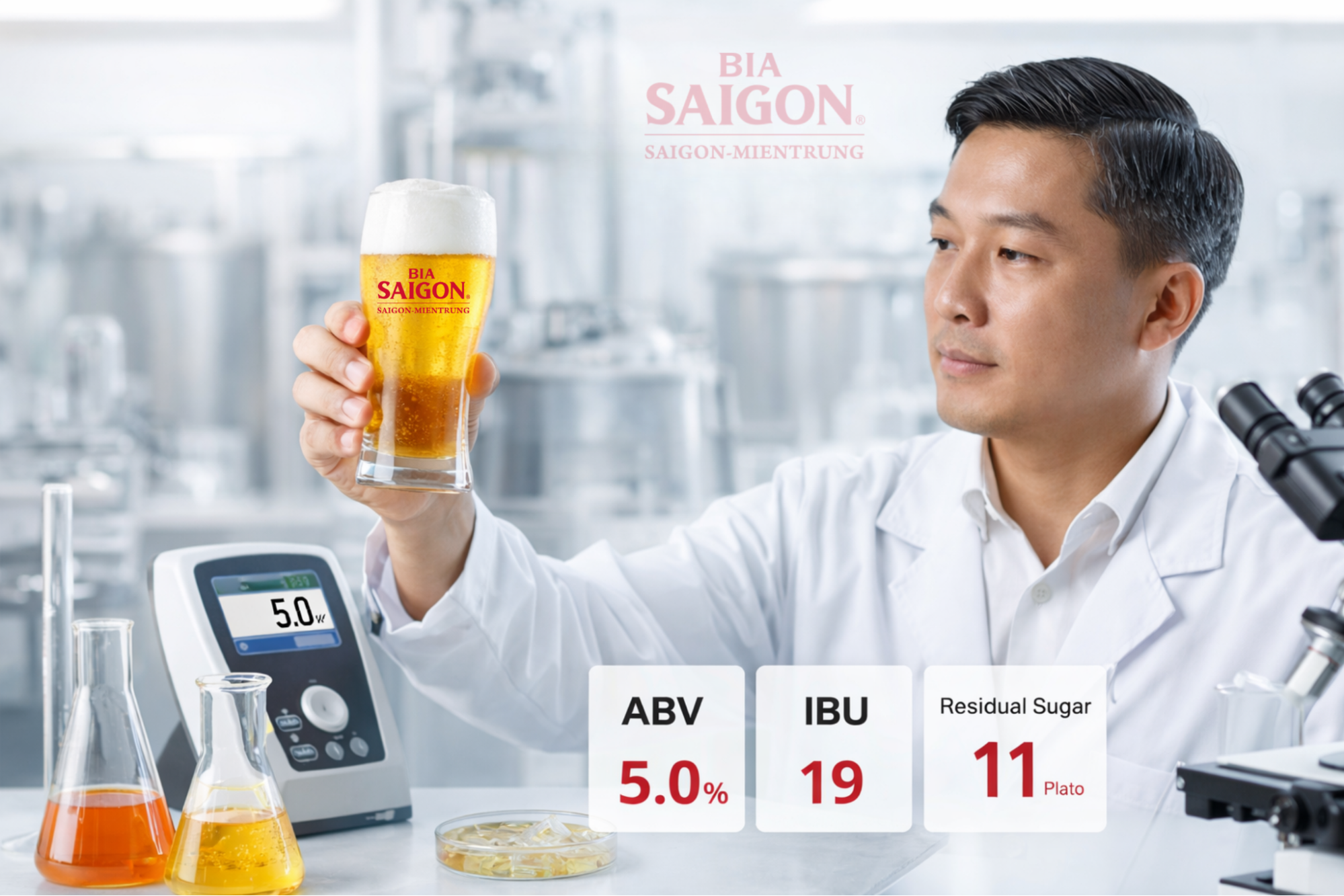
A single contaminated beer batch or a deviation in parameters can force an entire fermentation tank to be discarded. For an OEM brand, this not only causes financial losses but also damages the company’s image.
Therefore, modern beer production standards require a HACCP-based hazard analysis and critical control point (CCP) system, combined with ISO 22000 food safety management. This is also the quality management foundation applied at SMB in its beer OEM services, ensuring that every product achieves high consistency before leaving the factory.
Raw material control – The starting point of quality
A strict beer quality control process begins with raw materials.
Water – accounting for 90–95% of beer composition
Water must be thoroughly treated and tested for physicochemical and microbiological parameters. Multi-layer filtration systems and controlled demineralization ensure purity and flavor stability.
Malt and hops
Malt is tested for moisture, protein, and extract potential to ensure the mashing process achieves the correct Plato level. Hops are analyzed for alpha acid content to control bitterness (IBU), while oxidation is monitored to prevent off-flavors.
Brewer’s yeast
Yeast must maintain high purity, stable viable cell counts, and be free from contamination. This is one of the most risk-prone stages if not properly controlled.
Within SMB’s OEM system, every batch of raw materials has full traceability documentation. This helps control risks from the beginning and establishes a foundation for meeting international standards.
Brewing and fermentation monitoring – The heart of the QC system
Once raw materials meet standards, the entire beer production process is continuously monitored through critical control points (CCPs).
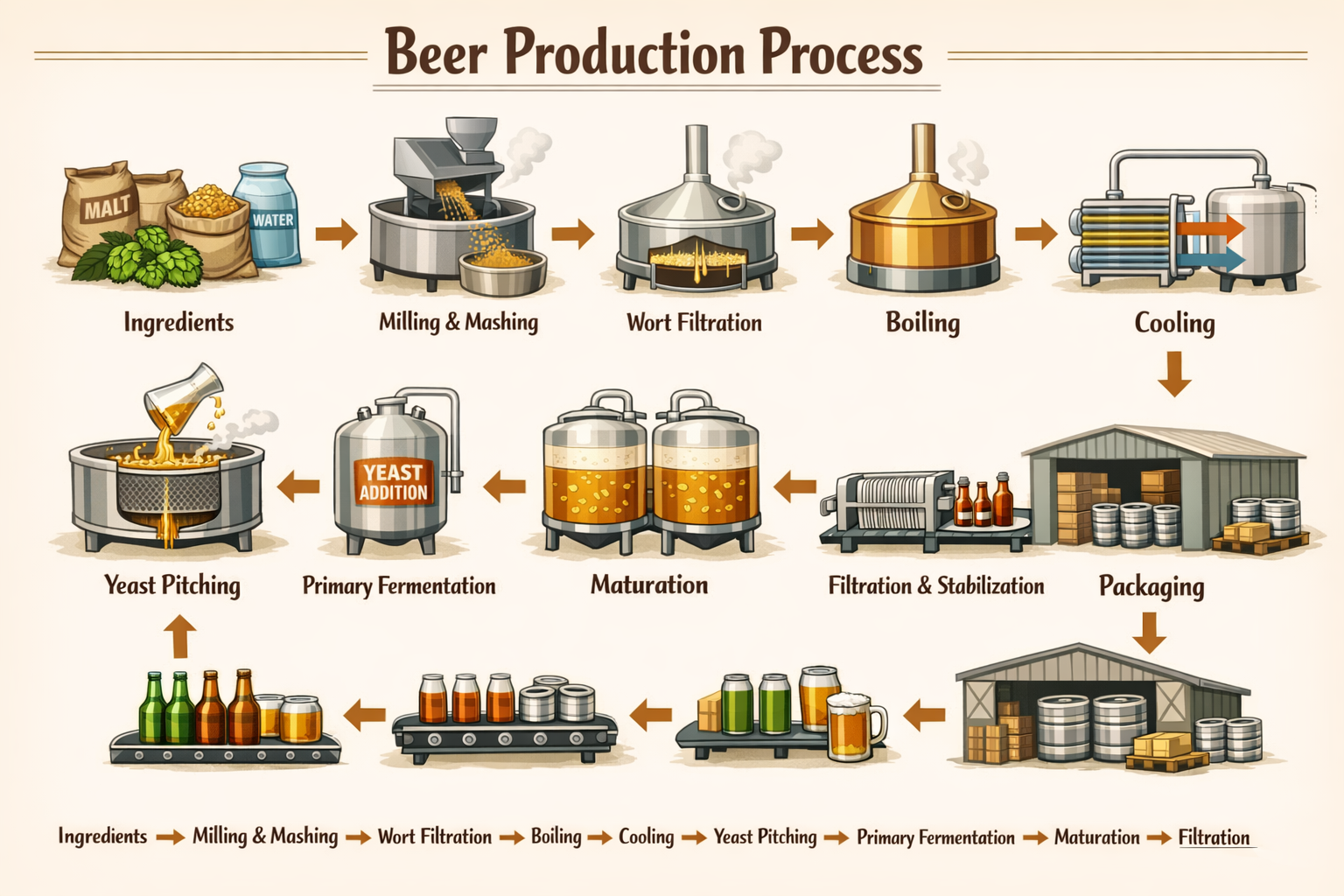
The control flow can be visualized as follows:
Raw materials → Milling & mashing → Wort filtration → Boiling → Cooling → Yeast pitching → Primary fermentation → Maturation → Stabilization filtration → Packaging → Storage.
In this chain, mashing temperature must be precisely controlled, as even small deviations can affect sugar structure and the final ABV. The sugar content is continuously measured to ensure the correct Plato specification according to the formula design.
The level of dissolved oxygen (DO) is closely monitored to prevent early oxidation. Closed fermentation tank systems and automated sensors help maintain a stable environment for the fermentation process.
SMB has invested in modern brewing and fermentation lines, combining automated monitoring with periodic manual inspections to ensure high consistency across OEM beer batches.
If you are looking for a partner with a structured QC system for your private label beer brand, contact experts directly for consultation:
📞 OEM Consultation Hotline: (+84) 94 1127575
📧 Email: oem@biasaigonmt.com
Laboratory analysis technology – Scientific proof of quality
An ISO-certified brewery cannot operate without a modern laboratory.
Here, alcohol content (ABV) is precisely determined using analytical systems. Bitterness (IBU) is measured through spectrophotometric methods, while sugar content is monitored using specialized density measurement equipment.
Most importantly, the beer microbiological testing system ensures safety. Samples are cultured to detect lactic acid bacteria, wild yeast, or harmful microorganisms. All data is stored for traceability when needed.
SMB operates an internal quality control system, enabling testing from raw materials to finished products, ensuring transparency and reliability for OEM partners.
Packaging and storage control – The final protective layer
Even if beer meets standards in the fermentation tank, risks can still arise during packaging. Checking seal integrity of bottles or cans, measuring CO₂ pressure, and monitoring the pasteurization process are mandatory steps.
Finished goods warehouse conditions must be strictly controlled, avoiding direct light exposure and high humidity. This helps limit oxidation and preserve product flavor.
SMB’s OEM services go beyond production, including support for packaging, final quality control, and ensuring proper storage conditions before delivery.
Choosing an OEM partner with a standardized QC system – A strategic decision for investors
For a private label beer brand, choosing an OEM partner is not just about finding a manufacturer but selecting a strategic partner. A company certified with HACCP, ISO 22000, equipped with an internal laboratory and a clear traceability system, will significantly reduce risks from the start.
Saigon Beer Central Region Joint Stock Company (SMB) provides comprehensive beer OEM services, from formula R&D, production, and quality control to legal support and packaging. With internationally standardized management and experience across various beer categories, SMB enables brands to build products that are both compliant and consistently stable.
QC – The foundation of a sustainable private label beer brand
In the beer industry, quality is not something that can be fixed by marketing. A strict beer quality control process helps:
- Maintain product consistency
- Protect brand reputation
- Minimize product recall risks
- Build trust with distributors
Partnering with an ISO-certified brewery like SMB provides OEM brands with a solid technical foundation and transparent QC data.
If you are looking for a high-quality beer OEM partner with an internationally standardized QC system:
Company: Saigon Beer Central Region Joint Stock Company (SMB)
Address: 01 Nguyen Van Linh, Tan An Ward, Buon Ma Thuot City, Dak Lak Province
OEM Consultation Hotline: (+84) 94 1127575
Email: oem@biasaigonmt.com
Website: https://oem.biasaigonmt.com/
Investing in quality today is the best way to protect your brand value in the future.