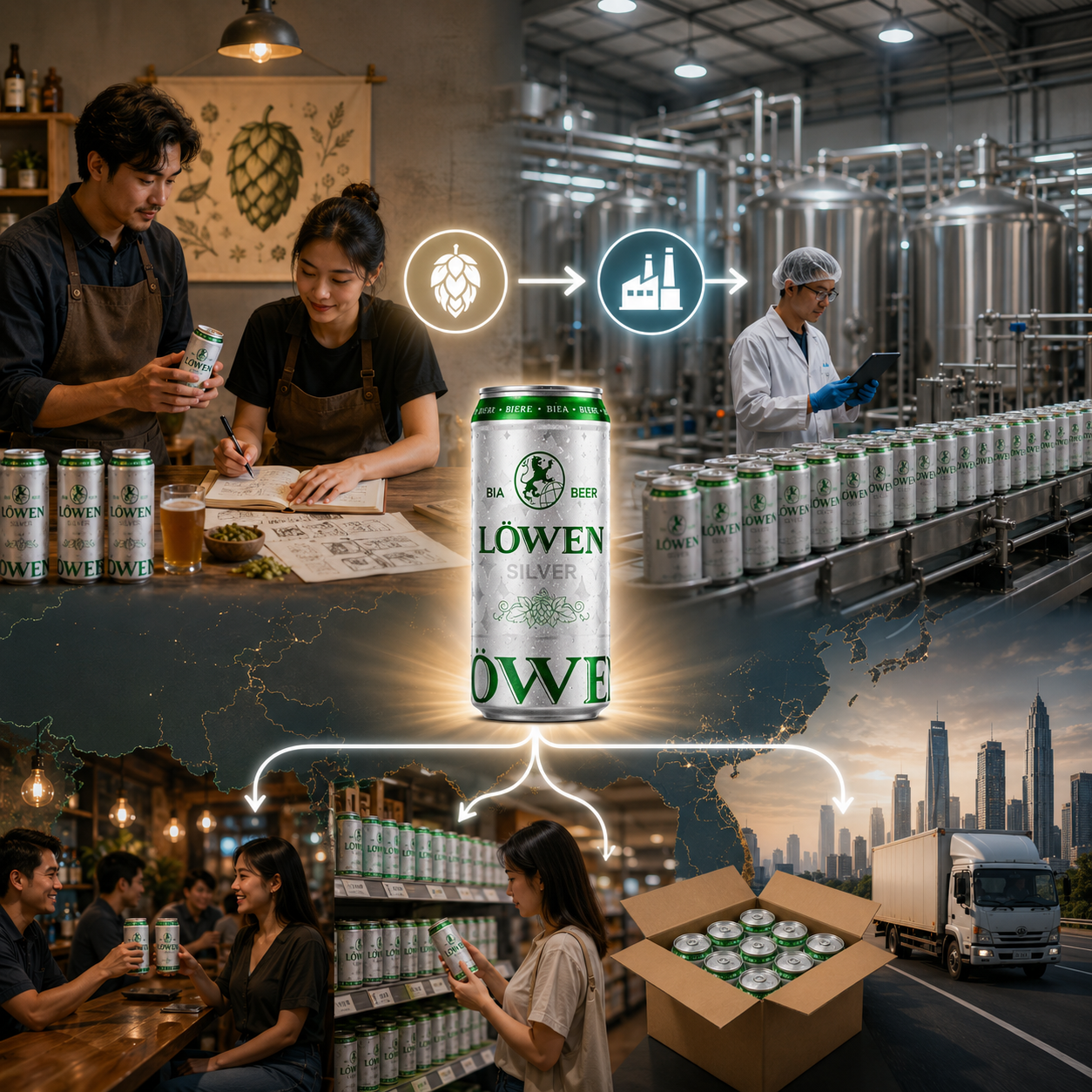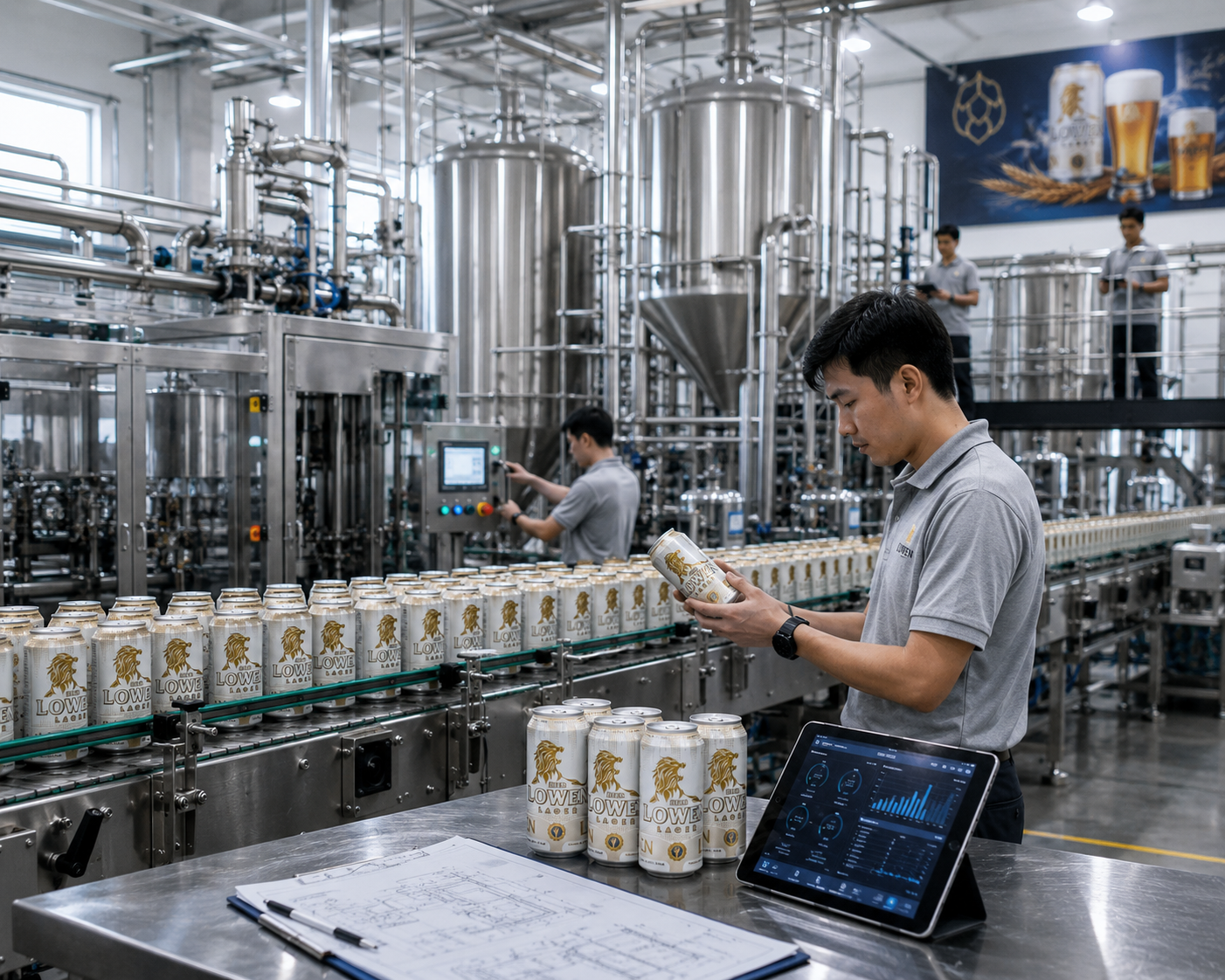


The beer market has traditionally been considered a playing field that requires substantial resources. Businesses that have been operating for many years often possess advantages in terms of breweries, distribution networks, marketing budgets, and brand awareness. This makes many small businesses or startups hesitant when they want to develop a private-label beer line.

However, the way businesses enter the market is gradually changing. A business does not necessarily need to own a brewery to develop its own product. Through the OEM beer contract manufacturing model, a brand can leverage the partner’s R&D capabilities, production lines, and quality control systems to focus resources on activities that directly create competitive advantages, such as customer research, brand building, marketing, and distribution channel development.
For small brands, the greatest value of OEM therefore does not simply lie in reducing production costs. More importantly, this model helps businesses narrow the resource gap with larger brands and enter the market in a more flexible way.
You Do Not Need to Own a Brewery to Own Your Own Beer Brand
The first barrier for a business that wants to produce beer itself is usually capital investment.
A brewery requires not only brewing, fermentation, filtration, and filling lines, but also water treatment systems, raw material warehouses, finished product warehouses, laboratories, technical personnel, quality management, and many other supporting facilities. After the investment, the business must also maintain operating costs even when production has not yet reached an optimal level.
For a small brand, allocating a large portion of its capital to fixed assets from the early stages can create significant pressure on cash flow.
OEM changes this equation by separating ownership of the brand from ownership of the brewery.
The business can still develop a product with its own name, image, and positioning while using the production system of a capable partner. Instead of investing substantial capital in facilities, machinery, and production personnel, the business can allocate its resources to market development.
This is particularly important for startups and small and medium-sized businesses. In the early stages, what they need to validate is not their ability to operate a brewery, but whether the market will accept the product.
The OEM model therefore allows a brand to start in a more streamlined way. When the product shows positive market signals, the business can continue increasing production volume without having to immediately address the issue of investing in production capacity.
If your business has an idea for a private-label beer but has not yet determined a suitable production solution, you can contact the OEM department of Sai Gon – Mien Trung Beer Joint Stock Company (SMB) via hotline (+84) 94 1127575 to evaluate the product direction and implementation potential from the early stages.
Small Brands Can Compete Through Speed Rather Than Scale
A small business is unlikely to compete with a large enterprise in terms of brewery scale or marketing budget. However, it has another advantage: the ability to make decisions quickly and focus on a specific customer segment.
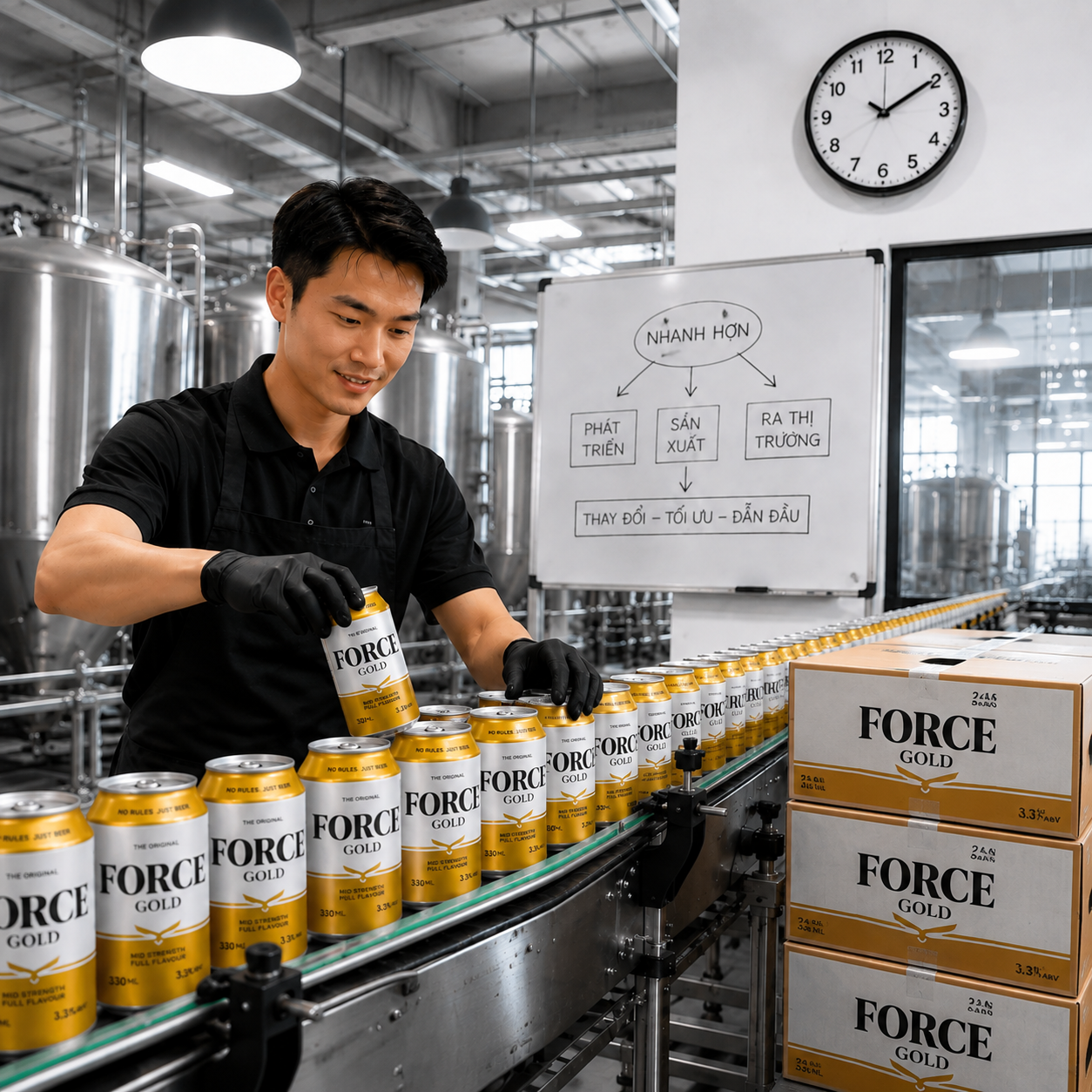
This is where the OEM model can demonstrate its value.
If a business builds its own production system, the time from idea to commercial product can be prolonged because the business must simultaneously address numerous issues related to technology, personnel, facilities, and legal requirements.
When using an existing production platform, many infrastructure investment steps can be shortened. The business can focus on product research, formula testing, packaging development, and sales planning.
Speed is particularly important when consumer preferences change rapidly.
A small brand may identify a demand for a beer line suitable for tourists in a particular locality, a product specifically designed for a restaurant chain, or a beer style serving a younger customer group. If it takes too long to bring the idea to market, that gap can quickly be exploited by competitors.
Conversely, the ability to develop and test products quickly allows businesses to respond more flexibly to market changes.
However, speed does not mean bypassing the process. The formula still needs to be researched, the product needs to be evaluated, and its ability to be produced at commercial scale must be validated.
This is why the R&D capabilities of an OEM partner play an important role. Small businesses do not simply need a brewery that accepts orders; they need a partner capable of turning market requirements into a product that can be produced consistently.
Businesses that already have ideas about flavor profiles or customer segments can send project information to Oem@biasaigonmt.com so that SMB’s specialized team can discuss product development directions.
You Do Not Need to Serve the Entire Market to Build a Competitive Advantage
One of the mistakes made by new brands is trying to compete directly with major brands in the mass market.
This is usually a highly resource-intensive competition.
Large brands have advantages in terms of market coverage, marketing budgets, distribution networks, and familiarity among consumers. If a small brand creates a similar product and uses the same approach, its ability to differentiate itself will not be high.
The advantage of a small brand lies in its ability to focus.
Instead of serving all consumers, a business can select a specific customer group and develop a product that meets that group’s needs.
A restaurant chain can own a beer line developed to pair with its menu. A tourism business can develop beer with a local story. A distributor can develop a brand suited to the taste preferences of a particular region.
When the target market is clearly defined, many decisions become easier. The formula can be developed according to specific taste preferences, the packaging can be designed for the target customer group, and the marketing message can also become more focused.
OEM creates the conditions for this strategy to be implemented without requiring the business to invest in a separate production system for each idea.
This is particularly meaningful in the context of an increasingly fragmented beverage market. Consumers do not choose products based solely on popularity; they are increasingly interested in flavor, story, design, and experiences that suit them personally.
A small brand does not necessarily need to become everyone’s choice. In many cases, becoming the most suitable choice for a specific customer group is already enough to build a valuable market.
Packaging and Brand Story Help Narrow the Awareness Gap
When they cannot spend a marketing budget comparable to that of large businesses, small brands need to make the most of every customer touchpoint.
Packaging is one of the most important touchpoints.
A well-designed beer can does more than contain the product; it can also communicate the brand’s positioning, style, and story directly at the point of sale. Particularly in social media environments, packaging can also appear in images, videos, and content created by consumers themselves.
This is a notable opportunity for small brands.
Instead of trying to create extremely broad media coverage, businesses can focus on building an image that is clear enough for customers to remember and distinguish easily.
A brand associated with tourism can incorporate local cultural elements into its packaging. A product aimed at younger customers can choose a more modern design style. A beer line serving a premium restaurant, on the other hand, needs to convey a completely different feeling.
The important thing is that the packaging, formula, and brand story must all move toward the same positioning.
A beautiful design that has no connection to the product experience will struggle to build a long-term brand. Similarly, a good formula with packaging that is not attractive enough may reduce the opportunity for customers to try the product for the first time.
When developing OEM beer, businesses should therefore work with the manufacturer from the packaging development stage. This helps ensure that the design concept is compatible with production specifications, packaging technology, and actual cost considerations.
Businesses can learn more about private-label beer implementation directions and SMB’s OEM capabilities at the website https://oem.biasaigonmt.com/ before finalizing their product plan.
Production Quality Helps Small Brands Build Trust
Marketing can help customers become aware of a product. Packaging can motivate customers to try the product. But to make customers come back, quality remains the foundation.
This is also one of the major challenges for small brands.
If production is organized independently with limited resources, the business must build from scratch a system for raw material control, production technology, technical personnel, and quality management. Even a small variation between production batches can change the customer experience.
Meanwhile, consumers today can share their experiences very quickly. An inconsistent product can directly affect the image of a new brand that has not yet built substantial trust in the market.
Partnering with an OEM brewery that has a well-established production system and quality control enables small brands to access a technological platform that would require significant resources to build independently.
However, businesses should not choose a partner based solely on the unit price.
R&D capabilities, the ability to maintain consistency between production batches, raw material management systems, production capacity, and supply chain capabilities all directly affect the brand’s ability to develop in the long term.

This becomes even more important when the product begins to grow.
A brand may start with a small market, but when it expands its distribution network or enters the peak season, production volume can increase rapidly. If the brewery does not have the capacity to meet demand, product shortages can cause the business to miss the best sales opportunities.
Therefore, choosing an OEM partner should be viewed as a strategic decision rather than simply selecting a supplier.
At Sai Gon – Mien Trung Beer Joint Stock Company (SMB), OEM operations are implemented on the foundation of industrial-scale beer production, combined with product research capabilities and a quality control system. Businesses that need to evaluate production options can contact the hotline (+84) 94 1127575 or email Oem@biasaigonmt.com to discuss directly with the specialized department.
OEM Helps Small Brands Focus Resources on What They Do Best
The most important advantage of beer contract manufacturing may not lie in the production activity itself.
The greater value lies in the fact that businesses do not have to spread their resources across too many activities at the same time.
Building a beer brand is already a complex task. Businesses need to understand customers, develop distribution channels, build sales teams, implement marketing, manage finances, and continuously monitor market responses.
If they also have to operate a brewery at the same time, the level of complexity increases significantly.
OEM allows businesses to redistribute these roles. The brewery focuses on R&D, production, quality, and technical requirements, while the brand owner allocates resources to the market.
For a small brand, this can be a major competitive advantage.
Businesses do not need to beat large brands in terms of brewery scale. Instead, they can compete through decision-making speed, deep understanding of a specific customer group, the ability to create differentiated experiences, and ways of building a community around the brand.
When the market responds positively, the business can continue expanding. If a product is not yet suitable, the brand can research and make adjustments before committing excessive resources.
This flexibility helps reduce risk when testing the market.
However, OEM is not a shortcut for bypassing the brand-building process. A good brewery can help create a stable product, but it cannot replace the business in identifying customers, building a sales system, or creating reasons for consumers to choose the product.
The most effective model is when both sides focus on their respective strengths.
The OEM partner takes responsibility for the production foundation, while the business focuses on creating demand and brand value.
This is also how a small brand can gradually narrow the gap with larger businesses without having to replicate their investment model.
In an increasingly diverse beer market, scale is no longer the only path to creating an advantage. A brand that understands its customers, has a suitable product, and responds quickly to the market can still build its own position.
OEM beer contract manufacturing makes this strategy more feasible by reducing barriers to production investment and allowing businesses to access established R&D capabilities, technology, and quality control systems.
If your business has an idea for developing a private-label beer, wants to test a new market segment, or needs a production platform to expand an existing brand, discussing the project with an OEM provider at an early stage will help clarify the appropriate formula, packaging, production volume, and implementation roadmap.
OEM Beer Consulting Contact Information
Company: Sai Gon – Mien Trung Beer Joint Stock Company (SMB)
Head Office Address: 01 Nguyen Van Linh, Tan An Ward, Buon Ma Thuot City, Dak Lak Province
OEM Consulting Hotline: (+84) 94 1127575
Specialized Email: Oem@biasaigonmt.com
Official Website: https://oem.biasaigonmt.com/