

The beer market is facing numerous changes as competition among businesses intensifies, production costs fluctuate, and consumer behavior continues to shift. In this context, growth is no longer measured solely by consumption volume but also depends on the ability to maintain operational efficiency, product quality, and adaptability to market conditions.

Competition in the Vietnamese beer industry takes place across multiple dimensions, from pricing and distribution systems to production capacity and supply chain management. These factors create pressure for both businesses with their own breweries and those using the OEM beer manufacturing model.
However, increased competition does not mean that all development opportunities are narrowing. Market changes can create a need to adjust product portfolios, improve efficiency, and adopt more appropriate management practices.
So, what factors can help the beer industry maintain its ability to grow in an increasingly complex competitive environment?
The Ability to Adapt to Changes in Market Demand
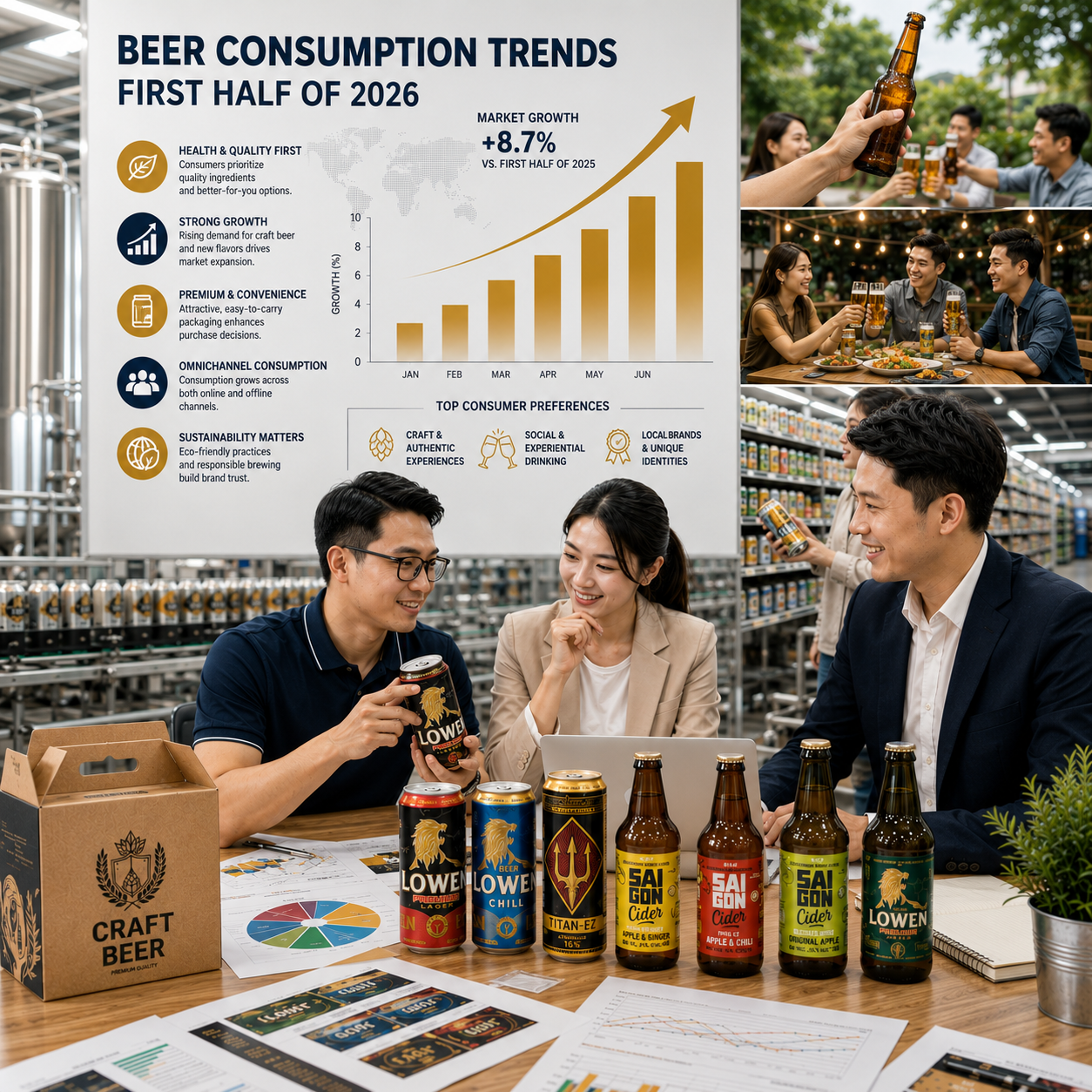
One of the factors affecting the development prospects of the beer industry is the ability to identify changes in consumer demand.
The market can no longer be easily viewed as a single, homogeneous customer group. Factors such as income, consumption occasions, shopping habits, and interest in non-alcoholic products can create significant differences between market segments.
This means businesses need to research demand within each market segment rather than relying solely on general consumption trends.
A small change in purchasing behavior can affect product composition, packaging specifications, and production plans. If businesses fail to update their information in a timely manner, their existing product portfolios may no longer meet actual market demand.
Conversely, understanding these shifts gives businesses a stronger basis for evaluating existing products and identifying necessary adjustments.
For private-label beer projects, market research is also an important step before submitting production requirements. The target segment, product characteristics, and expected production volume should be determined based on actual demand rather than subjective expectations.
To learn more about the factors that need to be prepared when developing OEM beer product requirements, businesses can contact SMB’s dedicated department via Email: Oem@biasaigonmt.com.
Improving Production Efficiency Helps Businesses Adapt to Cost Pressures
As competition intensifies, the ability to manage costs becomes one of the important factors affecting operations in the beer industry.
Production costs include not only raw materials but also energy, labor, packaging, equipment maintenance, and operational organization. Fluctuations in any of these components can affect the total cost of finished products.
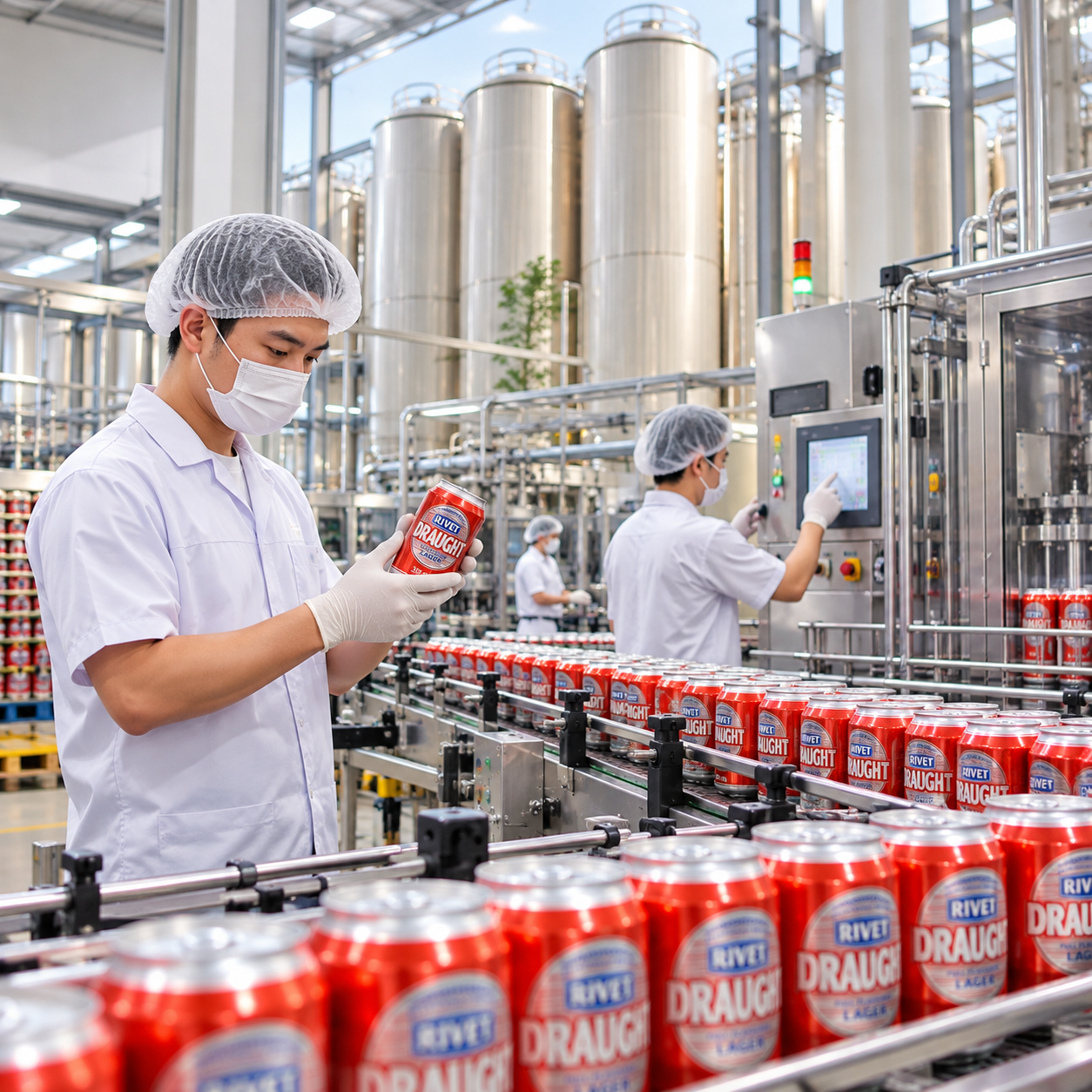
In this context, improving production efficiency can create significant value.
Monitoring loss rates, operating time, energy consumption, and raw material utilization efficiency helps factories identify areas that need improvement.
However, cost optimization should not simply be understood as choosing the lowest-priced raw materials or supplies.
If a cost-saving decision increases the risk of quality deviations, production disruptions, or non-conforming products, the actual total cost may be higher than expected.
Therefore, production efficiency needs to be evaluated alongside the ability to maintain quality control.
For the OEM model, clearly defining product specifications, production volumes, and ordering plans also helps the parties assess the cost structure more comprehensively.
A contract manufacturing project needs to be considered from both technical and operational planning perspectives. SMB receives OEM consultation requests via Oem@biasaigonmt.com to discuss the appropriate scope and implementation conditions.
Consistent Quality Is the Foundation of Long-Term Competitiveness
In the food and beverage manufacturing industry, quality is not evaluated solely based on an individual batch of finished products but also on the ability to maintain consistency throughout continuous production.
For beer, consistency depends on many factors, from raw materials and production conditions to testing, packaging, and storage.
As production volume increases, quality control requirements become more complex. Factories need to ensure that processes are carried out consistently and that information related to each production batch can be traced when necessary.
This control capability gives businesses a stronger basis for identifying causes when quality-related feedback arises.
In addition, an appropriate quality management system can help reduce the rate of non-conforming products and minimize unnecessary disruptions.
For businesses choosing an OEM manufacturing facility, these are criteria that need to be carefully considered.
Rather than focusing solely on manufacturing costs, businesses should learn about raw material control procedures, production management, finished product testing, and quality records.
Relevant standards or certifications should also be verified using actual information from each facility.
When evaluating a contract beer manufacturing project, businesses can send their product and quality control requirements to Oem@biasaigonmt.com to discuss them with SMB’s OEM department.
Distribution System Management Helps Prevent Supply-Demand Imbalances
Distribution is one of the important links in the beer industry, particularly when businesses operate across multiple market regions.
However, expanding the number of retail outlets does not always mean improved business efficiency.

If the volume of goods entering the distribution system increases faster than actual consumption, inventory may accumulate at distributors or points of sale.
This creates pressure on working capital, warehousing costs, and inventory management.
Therefore, businesses need to distinguish between sell-in, which refers to the volume of goods delivered into distribution channels, and sell-out, which refers to the volume of goods sold through the system.
These two sets of data provide different perspectives on market conditions.
When monitored alongside inventory levels and turnover rates, businesses can identify areas experiencing shortages or receiving production volumes that exceed demand.
In the beer industry, distribution is also associated with storage requirements and shelf-life management.
An effective distribution system therefore needs to ensure coordination between supply plans, storage conditions, and actual demand in each region.
To learn more about determining contract manufacturing volumes based on supply plans, businesses can contact SMB’s OEM department via Email: Oem@biasaigonmt.com.
A Flexible Supply Chain Helps Reduce the Impact of Market Fluctuations
Another factor affecting the beer industry’s ability to maintain operations is supply chain stability.
The production process depends on various groups of raw materials and supplies. When an important component is not delivered on time, production plans may be affected.
Fluctuations in delivery times, raw material prices, or packaging availability can also create cost pressures.
Therefore, supply chain management needs to strike a balance between stability and efficient resource utilization.
Maintaining excessively large inventories may help reduce certain material shortage risks, but it also increases capital requirements and storage costs. Conversely, excessively low inventory levels make production more vulnerable to disruptions when supply conditions change.
The solution lies in the ability to assess risks, develop plans, and coordinate across departments.
When demand data is updated regularly, purchasing and production departments can be more proactive in preparing raw materials.
For businesses using OEM beer manufacturing, sharing expected production volume plans with manufacturing partners is also part of the supply chain management process.
During the OEM planning stage, clarifying ordering schedules, product specifications, and production volumes can help businesses prepare more complete information. SMB receives consultation requests via Oem@biasaigonmt.com.
Technology, Policies, and Sustainable Development Shape Adaptability
In addition to factors directly related to production and distribution, the beer industry is also affected by technology, the regulatory environment, and sustainable development requirements.
Data management technology can help businesses monitor raw materials, production progress, inventory, and finished product information.

When different data sources are connected, planning can be based on more reliable information rather than depending entirely on manual estimates.
However, digital transformation does not necessarily have to begin with complex systems.
What matters more is identifying which data is truly necessary and how it can be used to improve operational decisions.
Alongside technology, businesses need to pay attention to legal requirements related to food safety, taxation, product labeling, advertising, and the environment.
Policy changes can affect cost structures, packaging options, or the way operations are organized.
Sustainable development is also increasingly linked to resource-use efficiency.
In beer production, water, energy, raw material, and waste management are directly related to operational activities.
Therefore, adaptability in the new period depends not only on factory scale but also on the ability to integrate technology, quality management, resource efficiency, and legal compliance.
Before implementing an OEM project, businesses can discuss product specifications and production scope requirements with SMB via Email: Oem@biasaigonmt.com to receive consultation based on their project information.
Sustainable Growth Needs to Be Built on Operational Efficiency and Adaptability
Amid increasingly intense competition, the development of the beer market cannot be evaluated solely through the rate of production volume expansion or the number of participating businesses.
An industry can continue to innovate in products, technology, and operational models even when consumption growth slows down. Therefore, it is necessary to distinguish between growth in market size and development in operational capabilities, efficiency, and quality.
The ability to understand consumer demand helps businesses evaluate and refine their product portfolios. Production efficiency supports cost control, while a stable quality system provides a foundation for long-term operations.
At the distribution stage, consumption and inventory data help prevent supply-demand imbalances. A flexible supply chain contributes to reducing the impact of external fluctuations.
At the same time, technology and compliance with management requirements are increasingly becoming important components of operational systems.
For businesses using the OEM beer manufacturing model, these factors demonstrate that the choice of a production solution needs to be considered in relation to product requirements, management capabilities, and supply plans.
Ultimately, the beer market’s ability to sustain growth also depends on economic conditions, policies, and changes in actual demand. No single solution can guarantee continuous growth.
Instead, adaptability, quality control, efficient resource utilization, and data-driven management will be important foundations that help businesses operate more stably in a competitive environment.
Contact Information
To learn more about the company and receive consultation on OEM beer manufacturing services, please contact Sai Gon – Mien Trung Beer Joint Stock Company (SMB) through its official contact channels.
Company: Sai Gon – Mien Trung Beer Joint Stock Company (SMB)
Head Office Address: 01 Nguyen Van Linh, Tan An Ward, Dak Lak Province
OEM Consultation Hotline: (+84) 94 1127575
Dedicated Email: Oem@biasaigonmt.com
Official Website: https://oem.biasaigonmt.com/