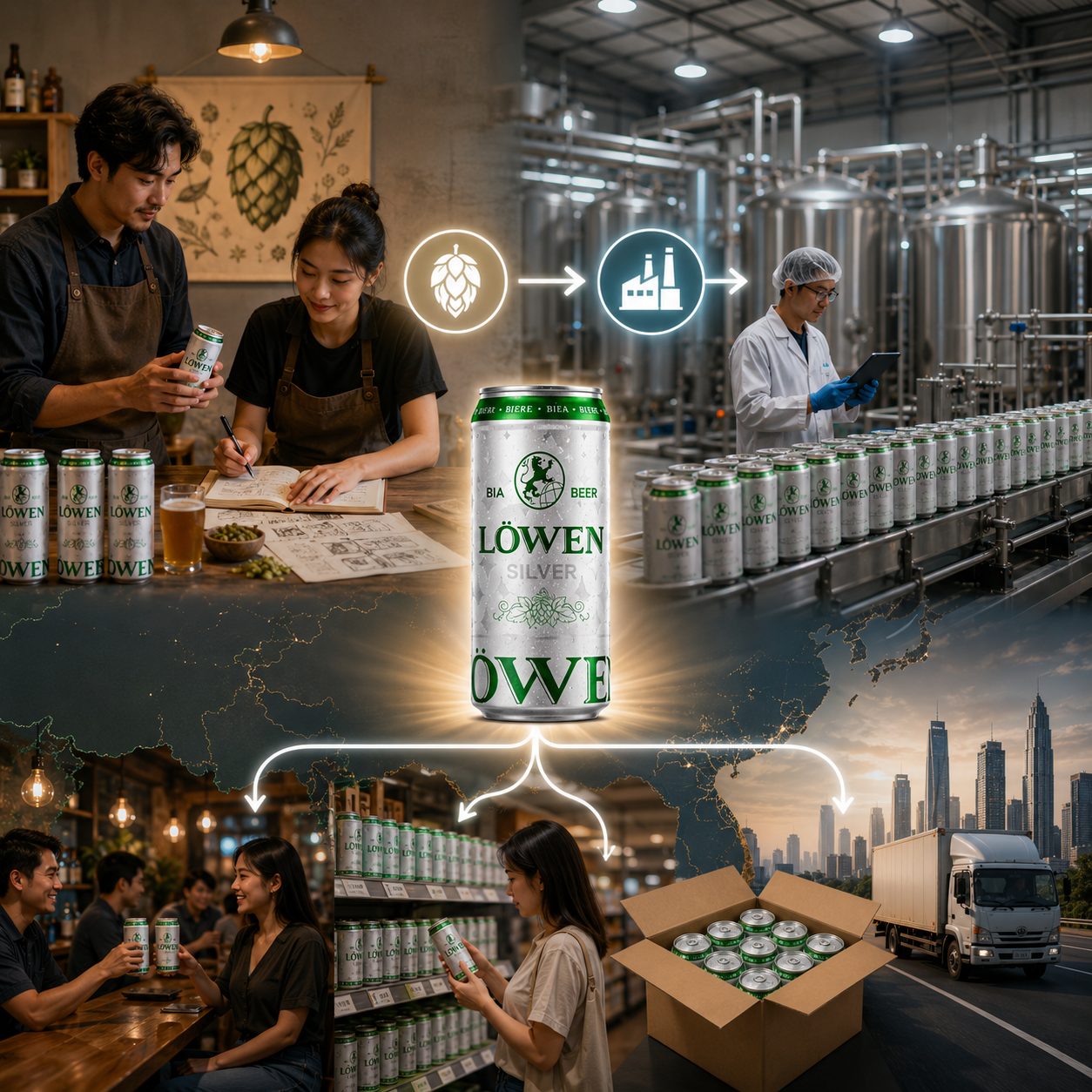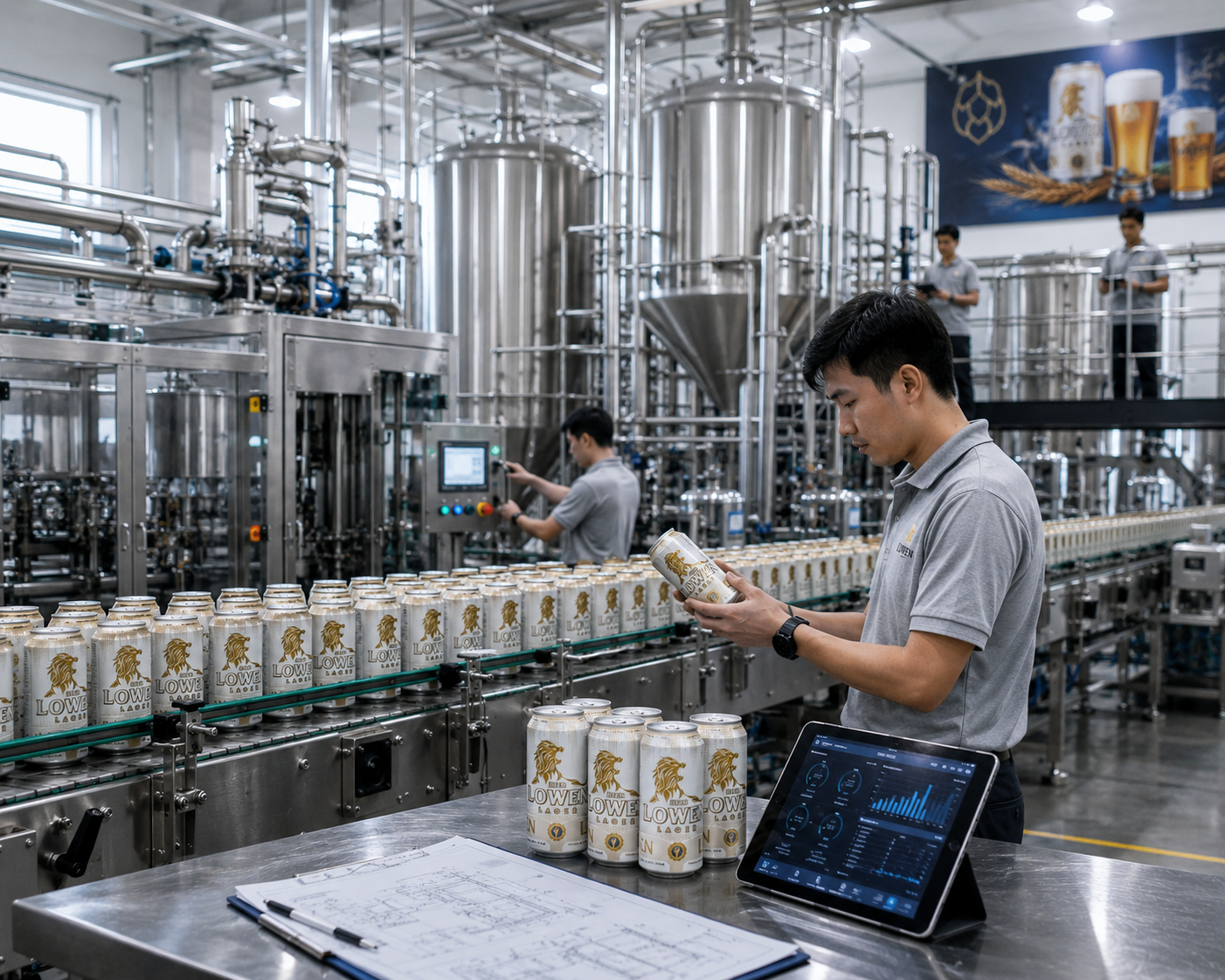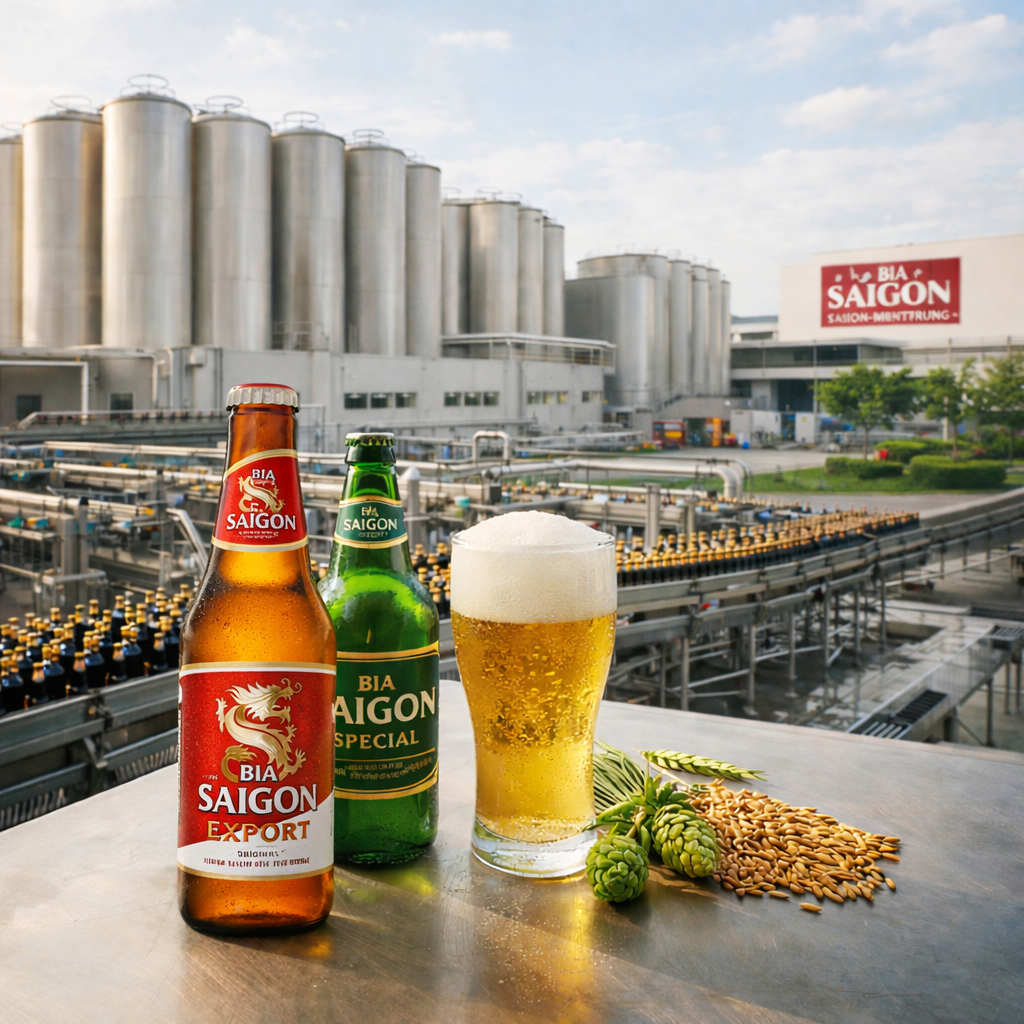


When deciding to develop a beer brand, businesses need to determine not only who their products will be sold to or how to build their brand, but also make another important decision: choosing the appropriate production model.

The two approaches commonly compared are partnering with an OEM beer manufacturing facility or investing in the construction of a private production facility.
Under the OEM model, a business utilizes the production capabilities of an existing manufacturer to develop products under its own brand, based on an arrangement agreed upon by both parties. Conversely, when investing in its own factory, the business directly develops its production capabilities, organizes personnel, operates equipment, and manages related activities.
Neither option is universally suitable for every business. OEM can offer advantages in implementation speed and reduce the need for initial investment in production assets, while owning a factory provides greater operational control if the business has sufficient scale, resources, and a long-term strategy.
Therefore, instead of asking “Is OEM or building your own factory better?”, businesses should consider which option is more suitable for their stage of development, available capital, and business objectives.
The First Difference Lies in the Scale of Initial Capital Investment
Building a brewery is a long-term investment decision. Businesses need to budget not only for production lines but also for land and facilities, infrastructure, production areas, auxiliary systems, warehouses, quality control laboratories, and many other related components.
After the initial investment phase, businesses must also establish an organizational structure to ensure the factory can operate.
This makes the self-manufacturing model more suitable for businesses that already have a long-term strategy, sufficient capital, and production demand large enough to utilize the capacity of their invested assets.
Meanwhile, the OEM beer manufacturing model takes a different approach.
Instead of building all production capabilities from scratch, businesses place orders with a factory that already has the necessary facilities and operational systems. As a result, initial resources can be directed more toward product development, packaging, marketing, and distribution networks.
This is particularly worth considering for new brands.
At a stage when there is limited data on consumer demand, investing substantial capital in fixed assets can create significant pressure. Meanwhile, OEM manufacturing allows businesses to test their business model before considering larger investments in production facilities.
However, OEM does not mean that no capital is required. Businesses still need to prepare budgets for production, packaging, minimum order quantities (MOQ), warehousing, distribution, and market development.
The main difference is that businesses do not have to establish an entire production facility from the outset.
If businesses are considering developing their own beer brands but do not yet want to invest in a private factory, they can contact SMB’s OEM department via Email: Oem@biasaigonmt.com for consultation based on their project requirements.
OEM Offers Advantages in Implementation Time, While a Private Factory Requires a Longer Roadmap
The speed at which a product is brought to market can significantly affect business plans.
When choosing to invest in a private factory, businesses must go through multiple stages before commercial production can begin. In addition to securing capital and constructing facilities, the process also involves equipment installation, personnel organization, establishing operational systems, fulfilling applicable legal requirements, and testing production operations.

This is an independent investment project rather than simply one step in the brand development process.
The OEM model can significantly shorten the preparation process for production facilities because businesses partner with a factory that already has operational capabilities.
The project timeline then focuses more on defining product requirements, agreeing on implementation plans, preparing packaging, production planning, and completing related tasks before bringing the products to market.
For new brands, this time advantage is particularly significant.
Businesses can collect market feedback earlier and use actual sales data to adjust their strategies. Instead of having to complete a factory before knowing whether the market will accept their products, brands can first test their commercial viability.
However, businesses still need to plan ahead. OEM does not mean that products can be manufactured immediately without time for development, material preparation, and production scheduling.
Businesses planning to introduce beer products under their own brands can send their anticipated requirements to Oem@biasaigonmt.com to discuss suitable implementation options with SMB.
A Private Factory Provides Greater Control, While OEM Reduces the Operational Burden
One important advantage of owning a factory is the ability to directly control production activities.
Businesses can independently develop production lines according to their product strategies, organize production schedules, and build their own technical teams. When operations reach a sufficient scale, these capabilities can become strategic assets.
In return, greater control comes with greater operational responsibilities.
Businesses must manage production personnel, equipment, maintenance, raw materials, quality, warehousing, and many other activities. When production lines operate below capacity, fixed costs still remain.
OEM transfers a significant portion of these responsibilities to the manufacturer.
Brand owners can focus on activities more closely connected to the market, such as customer research, distribution network development, marketing, and sales growth.
This represents a difference in the allocation of management resources.
A business with strong distribution capabilities does not necessarily need to become an expert in factory operations immediately. Similarly, a restaurant chain, hotel group, or trading company seeking to develop its own beer products may not have sufficient economic justification to build an entire production line.
However, using OEM also means that businesses must coordinate with their partners’ production schedules and operating conditions. Therefore, effective communication, planning, and selecting the right manufacturing partner become particularly important.
If a business aims to concentrate its resources on market development while utilizing a partner’s production capabilities, SMB is ready to discuss its OEM services via Email: Oem@biasaigonmt.com.
Costs Need to Be Calculated Based on Actual Production Volume
It is not possible to conclude that OEM is always cheaper than owning a factory, or vice versa, without comparing the two models at a specific production scale.
Under the OEM model, businesses pay the costs associated with products manufactured under contract, according to the agreed terms. Unit production costs are influenced by various factors, including production volume, formulation, packaging, and the requirements of each project.

With a private factory, businesses must consider a broader cost structure.
In addition to raw materials and packaging, there are asset depreciation, personnel, energy, maintenance, quality testing, warehousing, and other operating costs. When production volume is lower than the factory’s designed capacity, fixed costs are spread across fewer products, potentially putting pressure on unit production costs.
However, when a business reaches a sufficiently large production scale and operates its factory efficiently, the economics may change.
This is why long-term production volume is an important variable when choosing a production model.
New brands without historical sales data often find it difficult to accurately forecast production volumes over several years. OEM helps shift part of the challenge from investing in production capacity to placing manufacturing orders based on business plans.
Meanwhile, businesses with large production volumes, stable demand, and long-term manufacturing strategies may have stronger grounds for evaluating an investment in their own factories.
Therefore, the two options should not be compared solely based on the “production cost per beer can.” Businesses need to calculate the total cost of owning and operating each model over a sufficiently long period.
To discuss production volumes, product specifications, and contract manufacturing options before developing a cost analysis, businesses can contact SMB via Email: Oem@biasaigonmt.com.
OEM Helps Brands Remain More Flexible During the Market Testing Stage
One of the biggest risks for new brands is that actual market conditions may differ from initial forecasts.
A business may expect a product to achieve strong sales, but initial feedback may indicate the need to adjust its positioning, packaging, sales channels, or certain product characteristics.
If the business has already invested in a factory designed around its original plan, changing its strategy may become more complicated.
OEM provides a more flexible approach to production assets.
Businesses can begin with one flagship product, monitor sales and feedback, and then decide whether to expand their product portfolio.
Of course, the degree of flexibility still depends on minimum order quantities (MOQ), packaging materials, technical requirements, and the OEM factory’s capabilities. Therefore, businesses need to clarify these factors before implementation.
The key point is that brands can use market data before making larger investments in production facilities.
For example, after using OEM for a period of time, businesses may gain a clearer understanding of actual sales volumes, peak seasons, high-performing markets, flagship product lines, and expansion potential.
This data can be valuable if the business later considers building its own factory.
In this way, OEM and private factories are not necessarily two completely mutually exclusive options. Within a long-term strategy, OEM can serve as an initial stage for testing the market before a business reassesses its need to invest in production assets.
Businesses currently testing the market for their beer brands can contact SMB’s OEM department via Email: Oem@biasaigonmt.com to discuss their actual requirements.
When Should Businesses Choose OEM, and When Should They Consider a Private Factory?
The final decision should begin with the business’s strategy rather than market trends.
OEM is often worth considering when a business wants to introduce its brand to the market but is not yet ready to allocate substantial capital to production facilities. This model is also suitable when the business’s core strengths lie in its distribution network, customer base, food and beverage (F&B) operations, marketing, or brand development.

For new businesses, OEM also provides an opportunity to test market demand before making long-term investment decisions.
Conversely, investing in a private factory is worth considering when a business has sufficiently large and stable production volumes, long-term financial resources, a suitable operational team, and a need for greater control over production activities.
Another factor is the business’s future strategy.
If the business aims not only to manufacture products for its own brand but also to develop production capabilities into an independent business segment, the decision to invest in a factory may need to be evaluated from a different perspective.
Therefore, the appropriate question is not “Is OEM or a private factory better?”
Instead, the question should be:
“At our current scale and over the next 3–5 years, which model will make more efficient use of the business’s capital and capabilities?”
By answering this question, businesses will have a more practical basis for choosing the appropriate option.
SMB respectfully invites businesses exploring the development of their own beer brands to contact its OEM department via Email: Oem@biasaigonmt.com to discuss products, production volumes, and suitable contract manufacturing options.
OEM Beer Manufacturing or a Private Factory: The Choice Depends on the Stage of Development
Both OEM manufacturing and investing in a private factory offer distinct advantages.
OEM beer manufacturing allows businesses to utilize existing production capabilities, reduce the need for initial investment in production facilities, shorten implementation timelines, and focus resources on market development. These factors are particularly worth considering for new brands or businesses with strengths in commerce and distribution.
Meanwhile, a private production facility provides greater operational control and can become a strategic asset when a business reaches a sufficiently large scale. In return, it requires greater capital investment, personnel resources, technical capabilities, and operational management expertise.
A brand does not necessarily have to choose a single model for its entire lifecycle.
Businesses can begin with OEM to develop their markets, collect sales data, and refine their product portfolios. Once production volumes reach a certain scale, they can use this data to reassess the effectiveness of continuing with OEM or investing in their own production capabilities.
Therefore, the most suitable model is not necessarily the option with the lowest theoretical cost, but rather the one that best aligns with the business’s capital, production volume, management capabilities, and development strategy at each stage.
For new beer brands, not having to invest in a factory from the outset also allows businesses to allocate resources to an equally important task: developing a sufficiently large market to ensure that their products achieve actual sales.
Contact Information
To learn more about the company and receive consultation on OEM beer manufacturing services, please contact Sai Gon – Mien Trung Beer Joint Stock Company (SMB) through its official contact channels.
Company: Sai Gon – Mien Trung Beer Joint Stock Company (SMB) Head Office Address: 01 Nguyen Van Linh, Tan An Ward, Dak Lak Province OEM Consultation Hotline: (+84) 94 1127575 Dedicated Email: Oem@biasaigonmt.com Official Website: https://oem.biasaigonmt.com/