

When developing a new beer brand, businesses often devote considerable attention to the brand name, packaging design, flavor, and product launch plan. However, behind a commercial beer product lies another important decision: choosing the right OEM partner.

For businesses that do not own a brewery or do not want to invest immediately in their own production line, the OEM beer manufacturing model provides an opportunity to develop products under their own brand using the production capabilities of another company. This can help businesses focus their resources on brand building, distribution systems, and market development.
However, not every manufacturing provider is suitable for every project.
A new brand needs to consider more factors than simply the manufacturing cost. Production capacity, quality control capabilities, the level of support during product development, the ability to meet packaging specifications, and how the two parties cooperate over the long term can all directly affect the commercialization process.
So, how to choose the right OEM partner for a new beer brand? Below are 6 aspects businesses should consider before making a decision.
1/ Start with the brand’s actual needs
Before searching for an OEM brewery, businesses need to clearly understand what they need.
This may seem simple, but it has a significant impact on the partner selection process. A brand in the market testing stage will have different needs from a business that already owns a distribution network and is preparing to launch products on a large scale.
Businesses should identify their customer segment, intended product type, packaging specifications, expected production volume, and target selling price range relatively clearly. This information forms the basis for evaluating whether an OEM provider is truly suitable for the project.
For example, if a brand plans to develop products for a restaurant chain, the requirements for the product and packaging image may differ from those of a beer label targeting traditional retail channels. Similarly, businesses planning to increase production volumes in the future need to consider the provider’s ability to meet demand as order volumes grow.
A common mistake is to start looking for a brewery when the product direction is still too general. In such cases, comparisons between manufacturing providers can easily become limited to comparing quotations.
Meanwhile, a partner offering a suitable price may not necessarily be the best fit for the brand’s long-term objectives.
The more clearly businesses understand their projects, the more effective the process of searching for and communicating with an OEM beer manufacturing provider will be.
If businesses are at the idea development stage and need to discuss the feasibility of implementing their products, SMB is ready to receive project information and provide initial guidance via Email: Oem@biasaigonmt.com.
2/ Evaluate production capabilities instead of focusing solely on quotations
Manufacturing cost is certainly an important factor in business planning. However, if it becomes the only criterion for selecting an OEM partner, businesses may overlook many factors that directly affect the product in the future.
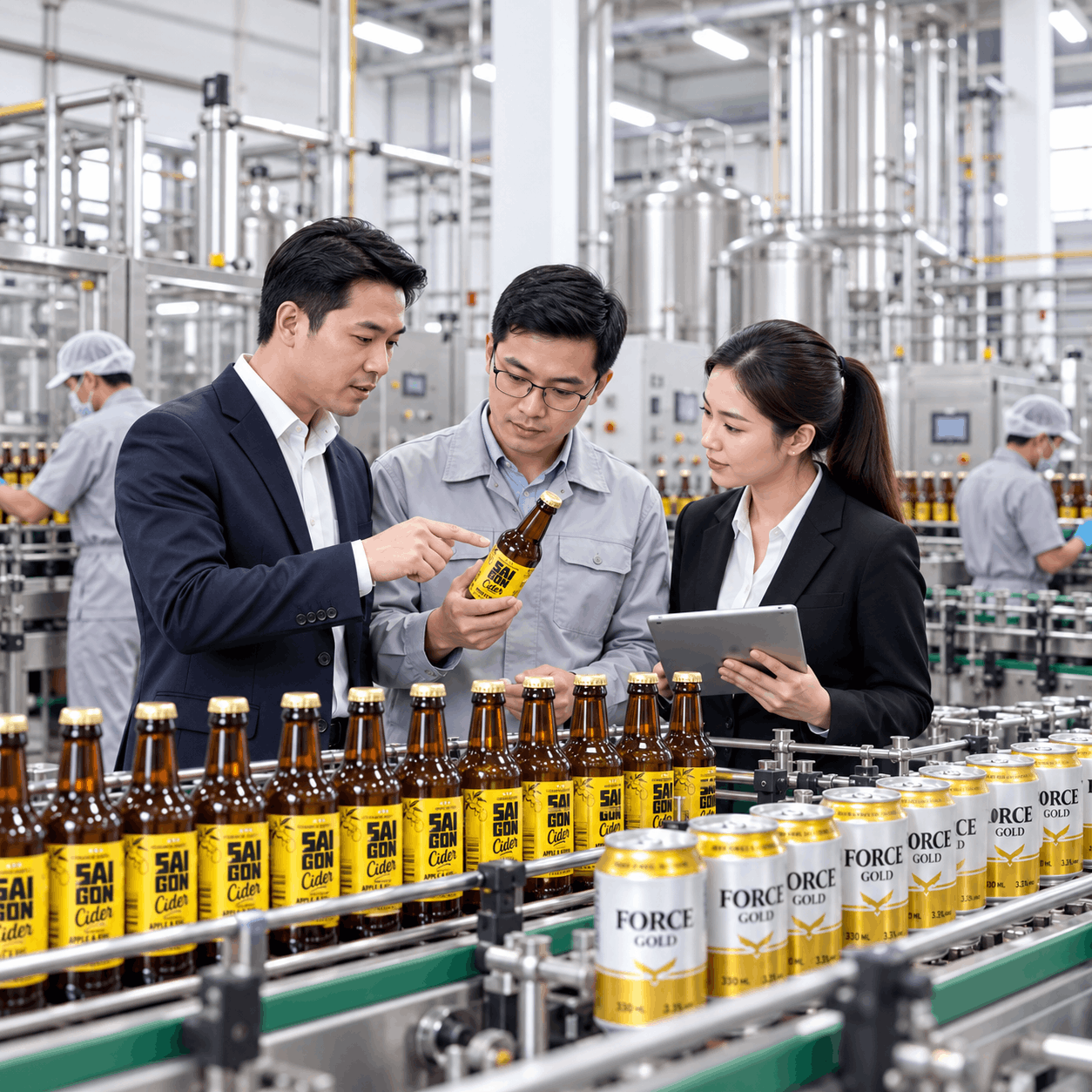
The first thing to consider is actual production capacity.
Businesses need to determine whether the OEM provider can meet the requirements for the intended product type, packaging specifications, and expected production volume. In particular, if the business plan aims for future expansion, the ability to meet production volume requirements as the brand grows should also be considered from the outset.
A suitable partner should not only fulfill current orders but also have the ability to support the brand through its subsequent stages of development.
In addition to scale, consistency in the production process is also very important. For consumer products such as beer, the customer experience needs to remain consistent across production batches. If quality varies significantly between production runs, businesses will face difficulties in building consumer trust.
Therefore, when evaluating a brewery, the question should not only be “how much does it cost to produce one unit?” but also “does this provider have sufficient capacity to meet the brand’s business plan in the coming period?”
Viewing the issue this way helps businesses select partners based on the overall value of the project, rather than focusing solely on a figure in the quotation.
Businesses interested in learning about manufacturing capabilities, product specifications, and production volume planning can contact SMB’s OEM department via Email: Oem@biasaigonmt.com for consultation.
3/ Consider product quality control capabilities
For a new beer brand, product quality directly influences the likelihood of customers returning after their first experience.
Packaging can attract consumers’ attention, marketing activities can encourage the first purchase, but the product experience itself is one of the determining factors in whether a brand can build a long-term market presence.
Therefore, when selecting an OEM partner, businesses need to pay attention to how the manufacturer manages quality throughout the entire process.
What matters is not only the finished product but also consistency between production batches. Once a brand has established a familiar experience, consumers generally expect a similar level of quality with their next purchase.
This consistency is particularly important when businesses begin expanding their distribution systems.
If a product is sold in multiple regions or through different channels, any significant inconsistency can affect the brand’s overall image.
Therefore, businesses should take the time to discuss production control procedures, quality management practices, and product-related matters with their OEM partner before signing a cooperation agreement.
This is not merely a technical issue for the brewery. For brand-owning businesses, it is also part of managing the product’s reputation in the market.
If businesses are looking for a solution to produce beer under their own brand and wish to discuss product requirements, they can contact SMB via Email: Oem@biasaigonmt.com for consultation tailored to their specific project.
4/ Prioritize partners capable of collaborating on product development
A new brand does not always start with a complete product specification.
Some businesses have only identified their customer group and price segment. Others have developed an idea for the product style but have not yet determined the packaging specifications. In some cases, the brand identity has already been finalized, but further discussions are still needed regarding the feasibility of actual production.

Therefore, consultation and collaboration capabilities are factors worth considering when selecting an OEM partner.
Rather than simply receiving requirements and providing quotations, a provider experienced in contract manufacturing can work with businesses to clarify the necessary information before moving to the production stage.
This discussion process helps businesses identify potential mismatches between their brand ideas and actual implementation conditions at an early stage.
For example, a business may propose a packaging option that is attractive in terms of design but does not match the intended production specifications. If the issue is identified before large-scale printing, the business can avoid subsequent adjustment costs.
Similarly, the target selling price range should also be discussed early. If the product configuration and packaging cause the production cost to become unsuitable for the target market segment, both parties need to consider alternative options before the project progresses too far.
For a new brand, a suitable OEM partner is therefore not merely a manufacturer, but also a provider capable of collaborating to bring the idea closer to actual production and commercialization conditions.
Businesses can send their requirements, product ideas, or brand direction to Email: Oem@biasaigonmt.com to discuss them with SMB’s OEM department before implementing the project.
5/ Clarify packaging, production volume, timelines, and costs before cooperation
Many issues during the contract manufacturing process do not arise from product quality but from the parties failing to fully agree on requirements from the outset.
Therefore, before deciding to cooperate, businesses should clarify the scope of work between the two parties.
An OEM beer project typically involves many components beyond the product itself. Cans or bottles, labels, cartons, design, order quantities, production schedules, and delivery plans can all affect the overall timeline.
Businesses should also clearly understand the cost structure rather than simply asking for a final price.
This is particularly important when comparing multiple OEM options. Two quotations may appear different at first glance, but their scopes of work, packaging specifications, or included items may also differ.
A lower price does not necessarily result in a lower total project cost.
In addition to costs, timelines should also be agreed upon based on the product’s market launch plan. If the brand intends to launch at a specific time, the business should discuss this with the brewery early to establish a suitable plan for the preparation stages.
Clearly defining responsibilities and project milestones helps reduce the risk of misunderstandings during cooperation.
Especially for new products, businesses should allow a reasonable period between production completion and commercial launch, rather than scheduling the launch too close to the production completion date.
For consultation on manufacturing options suitable for the expected production volume and implementation plan, businesses can contact SMB via Email: Oem@biasaigonmt.com.
6/ Select a partner based on the ability to provide long-term support
A successful beer brand typically does not end with the first order.
As the product begins to gain market acceptance, businesses may increase production volumes, expand distribution areas, adjust packaging, or develop additional product lines. Therefore, selecting an OEM partner should also be viewed from a long-term perspective.

Businesses need to consider the ability of both parties to communicate and coordinate. During product development, changes in plans or issues requiring resolution may arise. A clear communication mechanism will help these situations be handled more effectively.
Compatibility between the two parties also involves the ability to grow alongside the brand.
In the initial stage, a business may focus on one core product. As the market develops, demand may shift toward more packaging formats or additional product lines. Building a relationship with a partner capable of supporting subsequent stages of development helps businesses reduce the time required to search for a new partner and reestablish processes from the beginning.
This is also why businesses should not select a brewery based solely on the first order.
Instead, consider the question: If the brand develops successfully over the next two or three years, will this partner still be suitable for the business’s plans?
An appropriate OEM decision needs to balance product quality, production capacity, costs, collaboration capabilities, and the prospects for long-term cooperation.
SMB respectfully invites businesses planning to establish or expand their own beer brands to contact the OEM department directly via Email: Oem@biasaigonmt.com for consultation based on their project’s actual needs.
The Right OEM Partner Is Part of the Foundation of a Beer Brand
Selecting a contract manufacturing provider is one of the important decisions before bringing a new beer brand to market. The brewery may not appear directly in every marketing activity of the brand, but the production capabilities behind the product affect its quality, timelines, and ability to meet market demand.
Therefore, businesses should not search for a partner based solely on the question “Which provider offers the lowest manufacturing price?”
A more appropriate approach is to conduct a comprehensive evaluation: Does the partner understand the project’s requirements? Can it meet the expected production volume? What are its quality control procedures? Is collaboration between the two parties convenient and effective? And are its production capabilities suitable for the brand’s future development plans?
When these factors are considered from the outset, businesses have a stronger basis for selecting a suitable solution and reducing unnecessary adjustments during implementation.
For a new brand, the objective is not simply to find a facility capable of producing beer. More importantly, it is to find an OEM partner capable of working with the business to transform a product idea into a feasible and stable commercial project.
If a business is preparing to develop its own beer label, SMB is ready to receive project information and discuss product requirements, specifications, production volumes, and suitable contract manufacturing options.
Contact Information
To learn more about the company and receive consultation on OEM beer manufacturing services, please contact Sai Gon – Mien Trung Beer Joint Stock Company (SMB) through its official contact channels.
Company: Sai Gon – Mien Trung Beer Joint Stock Company (SMB)
Head Office Address: 01 Nguyen Van Linh, Tan An Ward, Dak Lak Province OEM Consultation
Hotline: (+84) 94 1127575
Dedicated Email: Oem@biasaigonmt.com
Official Website: https://oem.biasaigonmt.com/