

Beer labels not only provide product information but also play an important role in ensuring transparency, traceability, and compliance with laws governing goods.

Update for 2026: Decree No. 37/2026/ND-CP, effective from January 23, 2026, replaced the provisions on goods labeling under Decree No. 43/2017/ND-CP and Decree No. 111/2021/ND-CP. Therefore, beer label reviews now need to be based on the new regulations and relevant industry-specific regulations.
The article below analyzes six important areas of beer labeling for products circulated in Vietnam, including mandatory content, ingredient information, the responsibilities of relevant organizations, label presentation, and considerations for products manufactured under OEM contracts.
Legal framework and principles for beer labeling
Beer labeling in Vietnam is governed by general regulations on goods labeling and industry-specific regulations relating to food and alcoholic beverages.
Under Decree No. 37/2026/ND-CP, goods circulated in Vietnam must display mandatory information in Vietnamese. Basic information includes the product name, the name and address of the organization or individual responsible for the goods, origin, and additional content required according to the nature of each product group.
For beer, businesses need to identify all applicable food requirements while also reviewing specific regulations relating to alcoholic beverages.
Label content must be accurate, clear, and must not mislead consumers about the nature, characteristics, or origin of the product.
An important principle is that label information needs to be consistent with product documentation and actual data. Using unverified information may create legal risks, even when the packaging design has been finalized.
For products manufactured under OEM contracts, responsibilities for preparing, checking, and approving label content need to be clearly allocated among the relevant parties.
Mandatory information to be displayed on beer labels
Under the current regulatory framework for goods labeling, the basic information on beer labels for products circulated in Vietnam needs to be determined according to the food category and applicable industry-specific requirements.
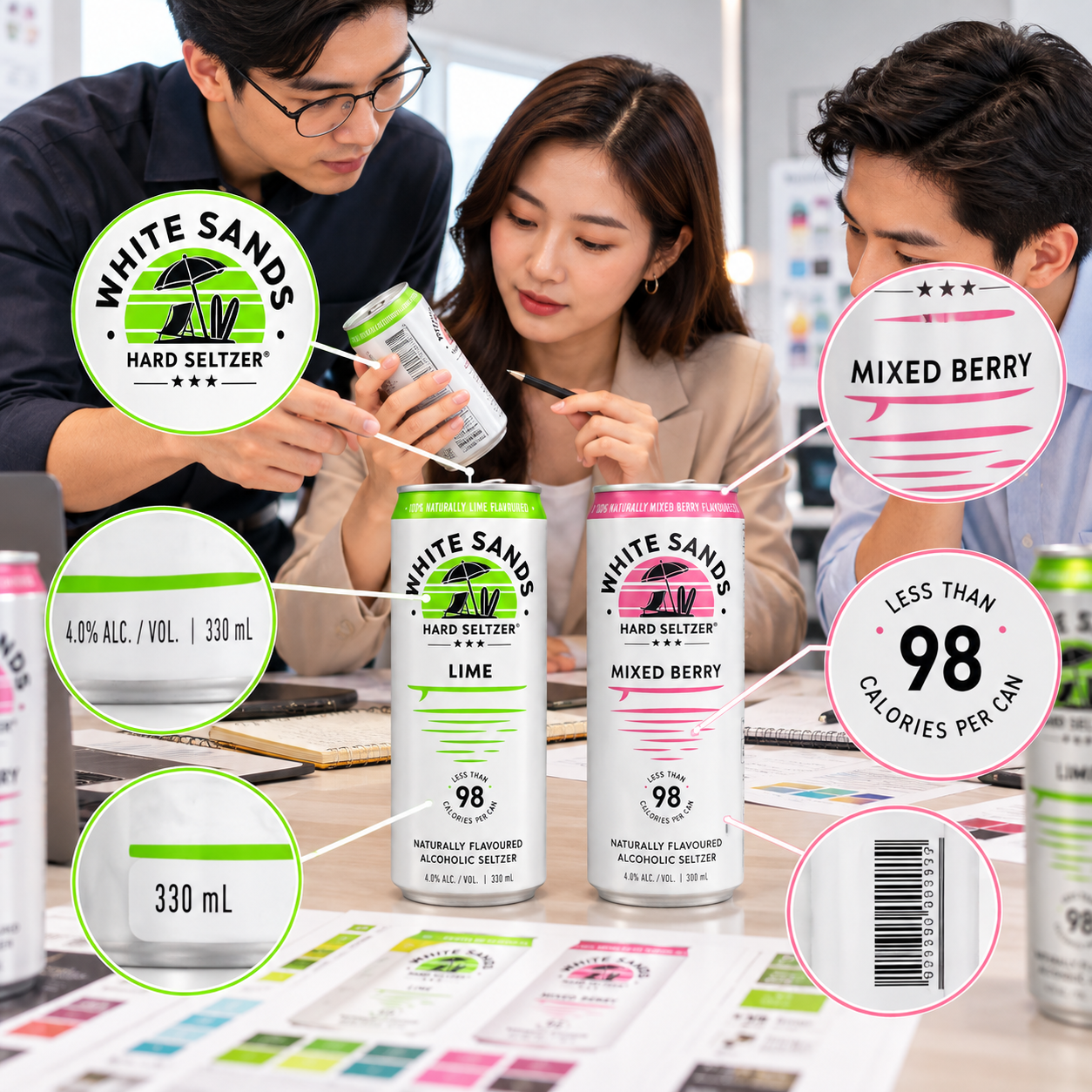
The information to be reviewed includes:
- Product name: Accurately reflects the nature of the product.
- Name and address of the organization or individual responsible for the goods: Identifies the responsible entity as required by regulations.
- Origin of goods: Stated truthfully and in accordance with regulations on determining and indicating origin.
- Net quantity: Indicates the volume or an appropriate unit of measurement.
- Manufacturing date and expiry date: Stated in accordance with the regulations applicable to the food category.
- Ingredients or quantitative ingredient declarations: Accurately reflect product information.
- Warning information: Displays mandatory warnings under relevant regulations.
- Instructions for use and storage: Provides necessary information according to applicable requirements.
Requirements for nutritional composition and nutritional values need to be determined according to the relevant regulations and implementation timelines. It should not be assumed that every product must display the same nutrition table.
For beer, alcohol content information also needs to be checked against industry-specific regulations. This is important for accurately presenting the product’s characteristics.
Businesses should not rely solely on the label of a product already on the market when developing a new label, as products may differ in ingredients, origin, specifications, and labeling obligations.
Ingredients, net quantity, manufacturing date, and expiry date
For beer, ingredient information needs to accurately reflect the product formulation and the raw materials used.
Ingredients must be presented in accordance with applicable labeling principles, including specific requirements for ingredients that must be declared or information related to food safety warnings.
Businesses also need to accurately determine the product’s actual volume and how measurement units are displayed on the packaging.
The manufacturing date and expiry date must be consistent with the product documentation. If symbols or a separate printing location on the packaging are used, the presentation needs to enable readers to identify the information as required by regulations.
In particular, businesses need to distinguish between the manufacturing date, expiry date, and best-before date. These forms of date marking should not be substituted arbitrarily without determining the applicable basis.
These requirements are set out in Appendix I to Decree No. 37/2026/ND-CP for the food category.
Warning information and requirements for alcoholic beverages
In addition to product information, businesses need to review the warning requirements applicable to beer.
Decree No. 37/2026/ND-CP stipulates that warning information is one of the labeling requirements for the food category.

However, a distinction must be made between mandatory warnings on product labels and mandatory warnings in alcohol and beer advertising.
Under Decree No. 24/2020/ND-CP, beer advertising must meet specific requirements for warning content on preventing and reducing alcohol-related harm. All requirements governing the presentation of advertising warnings should not automatically be applied to product labels.
For labeling, businesses need to check the industry-specific regulations applicable to the particular product while ensuring that the information does not mislead consumers about its characteristics and safety.
Information relating to alcohol content, ingredients, and necessary warnings must be checked against the technical documentation before label approval.
Name and address of the responsible entity and origin of goods
One of the important elements on beer labels is information about the organization or individual responsible for the goods.
For products manufactured under OEM contracts, multiple parties may be involved, including the brand owner, the manufacturer, and organizations involved in distribution.
However, each party’s commercial role does not automatically determine how its information is stated on the label.
Businesses need to identify the responsible entity according to legal requirements and the product’s actual documentation.
Origin information must also be presented truthfully. The location of the brand owner’s head office is not necessarily the sole basis for determining the origin of goods.
For imported products, requirements for original labels and supplementary labels in Vietnamese need to be considered separately.
Under Decree No. 37/2026/ND-CP, imported goods whose labels do not display all mandatory information in Vietnamese must comply with supplementary labeling requirements before being circulated in Vietnam.
Therefore, company and origin information need to be checked against relevant documents rather than relying solely on the design department’s proposed presentation.
Considerations when reviewing and approving beer labels
Label reviews need to be conducted before businesses approve the final design.

For OEM projects, the review process should bring together information from product documentation, the technical department, the design agency, and the department responsible for legal matters.
A compliant beer label must not only contain all required information but also ensure accuracy and legibility.
Under current regulations, letters and numbers must be sized to ensure clear presentation while complying with relevant measurement regulations. Small packaging is subject to specific labeling arrangements that need to be checked against the applicable conditions.
Businesses also need to note that using QR codes or electronic labels does not mean they may remove all information from physical labels.
Decree No. 37/2026/ND-CP introduced provisions for electronic labeling, but the scope of information that may be presented through this method depends on the corresponding legal conditions.
In addition, changes to the formulation, specifications, responsible entity, or origin may require updates to label content.
For packaging printed before Decree No. 37/2026/ND-CP took effect, businesses need to consider the transitional provisions rather than automatically assuming that all existing materials can no longer be used.
Compliance with labeling regulations is part of product quality management
Beer labels present important information about the product and the responsibilities of the organizations involved.
Accurate labeling helps ensure transparency, supports traceability, and reduces risks during the circulation of goods.
For businesses undertaking production under OEM contracts, label content should be prepared alongside the completion of technical documentation and the allocation of each party’s responsibilities.
In particular, from January 23, 2026, businesses need to pay attention to the changes introduced by Decree No. 37/2026/ND-CP rather than relying solely on guidance based on Decree No. 43/2017/ND-CP and Decree No. 111/2021/ND-CP.
A compliant beer label must ensure completeness, accuracy, legibility, and compliance with the regulations applicable to the specific product.
Before putting packaging into use, businesses should conduct a final legal review to ensure that the information presented is consistent with product documentation and current regulations.
Contact Information
Company: Sai Gon – Mien Trung Beer Joint Stock Company (SMB)
Head Office Address: 01 Nguyen Van Linh, Tan An Ward, Dak Lak Province
OEM Consultation Hotline: (+84) 94 1127575
Dedicated Email: Oem@biasaigonmt.com
Official Website: https://oem.biasaigonmt.com/
Note: This article provides general legal information as of November 2026.